Tales of the Kung Fu Warriors — #aComicaDay (1)

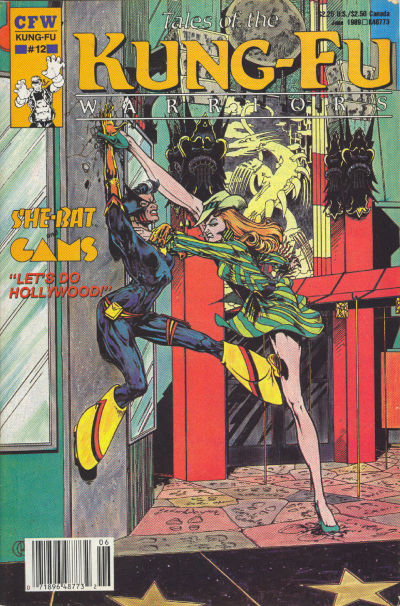
Tales of the Kung-Fu Warriors #12 is one of those comics you buy purely for the cover.

Gams, a red headed gal in a dark and light green striped short skirt and heels uses her right leg to pin the She-Bat up against a wall having caught her right arm. She is choking She-Bat who holds off Gams by pushing with her left lef against Gam's left leg, her other leg pushing against the wall. She-bat is dressed in a black skin tight suit with flared yellow boots, is dark haired and latine.

Welcome to a new feature in which I show off a random comic from my collection every day, now that I finally have access to them again. We start with one of the most obscure issues in my library, something I must’ve picked up at some random con or comics shop purely based on the strength of the cover and recognising the character on the left. The issue itself is from June 1989 but I got it sometime in the early nineties as far as I can tell. At that time, the cover artist, Daerick Gröss, had become a minor “hot” artist, due to his work for Innovation on the Anne Rice’s Vampire Lestat and Forbidden Planet adaptations. Gröss was already forty when he started doing comics in 1988; judging from his Wikipedia entry his career was largely over by the late nineties. He passed away last year.

In 1991 he had gotten his own series at Heroic, Murciélaga She-Bat, also featured here, which was enough for me to pick this up. At the time I always liked to find obscure superhero titles regardless of quality. Not that this was bad: just one long battle between Gams, with the striking legs and She-Bat, continually on the defence. Well drawn and laid out, it’s the best story in the issue. Gross definitely is the best artist in the issue, though none of the others are bad, just mediocre at best.

There are four more stories in this issue. Silk, by Vincenzo Tripetti, is about an MMA match between Silk and a cheating Soviet athlete, when that just still barely possible as a plot. Fun thing is that she wasn’t cheating for the glory of the USSR but because she was hired by a crooked promoter. Steven Ross’ Dragon Dancer for some reason has machine lettering instead of proper lettering like the other stories and is incomprehensible. Just could not read it properly, also due to the lettering.

Moonlight Cutter, by Dale Berry, is a standalone story about a samurai with a sword that can cut ghosts. Moody and fun it’s the second best story in the issue. Finally, Kung Fu Dog is a Neal Yamamoto funny animal story about two dogs in search of David Carradine. Rounding off the issue were various ad pages choked full of ninja and kung fu stuff and a back cover ad for another CFW title, Shred, featuring a gimp masked leather clad skate boarder (who also cameos in the She-Bat story). As a whole, Tales of the Kung-Fu Warriors is from a time when you could still make a living from doing low effort “sub culture” comics like this; judging from the editorial it used to be a magazine converted to the comics format and it certainly reads that way. A glimpse in an entirely different comics culture far away from ‘mainstream’ superheroics.

2000AD: a personal history

Discourse 2000 is a new project started by Tom Ewing, looking at the history of 2000AD. He explains why and how in its first installment:

I’ve wanted to write about 2000AD for years. It means a lot to me. It means a lot to most British comics readers of my age and a fair spread of years around that, I’d guess. A lot of my aesthetic sensibilities, in comics and frankly beyond them, are rooted in what 2000AD did to me at a tender age. Acquire a taste for thrill-power when your brain is young and open and it never really leaves. This blog is my attempt to do right by the comic.

Its format is simple. I’m not a historian in the archival, dates and interviews and reconciling sources sense. This is a critical history of 2000AD, in that I’m arranging its entries so they tell a roughly chronological story – but the emphasis is on criticism, which means I’m more interested in what appeared in the Prog than the details of how it got there.

But I’m interested in everything that appeared. Each entry will look at a different strip; each strip will get its own entry. I’m taking 2000AD a year at a time, aiming to cover the first 10 years at least, and long-running features with multiple stories (most obviously Judge Dredd) will get an entry for each year. But something like Inferno, which starts in 1977 and runs into 1978, will only get the one write-up. Sometimes the entries will stick closely to a discussion of the strip; sometimes they’ll range more widely. Britain in the late 70s and early 80s was a volatile, exciting place, even as it was also tacky, venal, and nasty. There’s a lot going on.

I didn’t get to 2000AD myself until a decade later, my entry point being, as it was for so many, Judge Dredd. Dredd had had a shortlived comics series in the Netherlands and I had gotten into superhero comics and he was close enough to one, right? That particular series ran for less than ten issues but did the Brian Bolland Cursed Earth saga which was mindblowing to a fourteen year old. Maybe even more important for a young metal head, Dredd had been namechecked in the liner notes for Anthrax’s Among the Living album, alongside such other late eighties comics like TMNT, The Dark Knight Returns, Watchmen, Byrne’s Fantastic Four, Miller’s Daredevil, Boris the Bear and D.R. and Quinch, with Bolland, John Wagner, Ron Smith and Carlos Ezquerra also mentioned. The Anthrax boys were serious comics fans it seems and rare, knew their 2000AD. And what really fried my eighties nerdy teenage brain was this:

Anthrax wasn’t the only rock band to be inspired by Dredd of course; The Human League of all bands did their own version of I Am the Law. For me, it came at exactly the right time to drag me further into the comics rabbit hole. If a band as cool as them liked comics, liked Dredd, than comics must be cool too.

2000AD itself remained elusive to me however: it was only in 1990 or so that the local comic shop started carrying it, starting with prog 700. That was the first one I ever bought and I would continue buying it up until prog 824. In hindsight, this was one of the zine’s golden ages, with excellent new Dredd and Psi Judge Anderson stories and an influx of new talent like Garth Ennis, Philip Bond, Jamie Hewlett, Peter Milligan and John Smith. There was also the return of Grant Morrison and Zenith, one of those strips I’d only ever read about rather than had read. Reading this weekly was great, even if not every story or comic was to my liking. Every prog would have at least something interesting.

Over the decades since, 2000AD has only been an intermittent interest to me, to be sure. I haven’t read the zine since, but rather have bought the occassional collection of classic series, like Halo Jones or Strontium Dog. But at Worldcon this year I got curious again about that period in UK comics, roughly from 1988 to 1993 or so when it seemed that 2000AD might’ve brought into being a new sort of adult comics zine in Britain: Revolver, Crisis, Toxic, Blast. All sorts of earnest, mature monthly titles suddenly sprung up and seemed to have created a new market for a more grownup version of the 2000AD. Alas, all of them were gone in a year or two and it remained a pipedream, but seeing those on sale at the one comics dealer at Worldcon piqued my interest again. A lot of interesting ideas and comics were tried out in those years and much of it was first nurtured by 2000AD.

Tom Ewing’s new project therefore comes at the perfect time for me and judging by its first four released chapters, should be required reading for anybody curious about 2000AD.

This is Superman — Friday Funnies

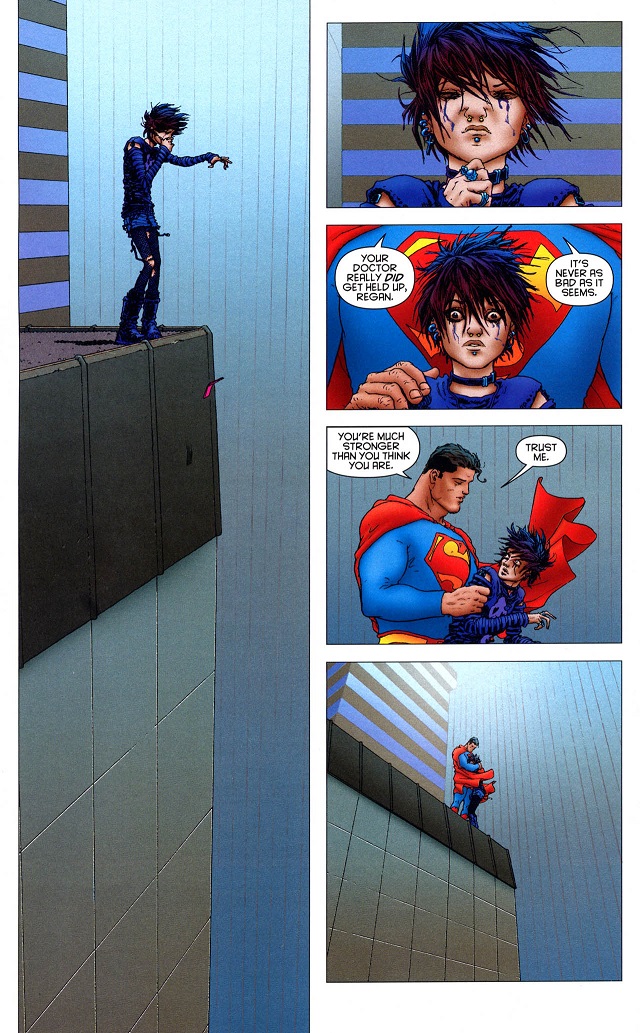
If that first page of Grant Morrison & Frank Quitely’s All Star Superman is justifiably famous for summing up Superman’s origin in four panels, this page from All Star Superman issue ten does the same for summing up in five panels who Superman is as a person:

A goth girl stands on the ledge of a tall building. She drops her phone, closes her eyes and prepares to jump. Superman appears behind her and tells her her doctor was really held up and that's she is stronger than she thinks she is. They hug

For context, Superman is dying and this issue has him starting writing his will, while he is also busy trying to resolve as many crisises and disasters as possible while he still can. In the overall scheme of what’s at stake the life of one confused, scared girl may seem meaningless but Superman still takes the time to not just rescue her, but comfort her. He does so without knowning her, without anybody having asked him to save her, he does because he couldn’t help but overhear her doctor frantically calling her to not do anything drastic and took it upon himself to make sure she didn’t

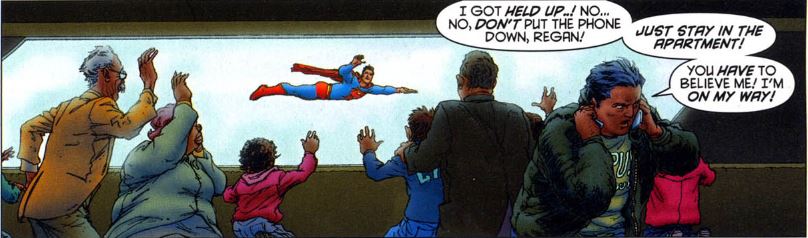
Superman flies by in the background as passengers of a runaway train wave to him. In the foreground a person is calling somebody urging them to stay on the line and not hang up, telling them he is on his way.

All Star Superman is full of moments like this, showing how well Morrison and Quitely understood him. On a technical level, the layout of that page is just brilliant, one long panel on the left, four smaller panels next to it on the right, fully emphasising the height of the building Regan is standing on the ledge of.

Yes of course being lesbian is more queer than cross-dressing

Even without context, saying that heterosexual romance story is somehow more queer than a lesbian love story just because the bloke in it cross-dresses is bizarre:

“why can’t it be two girls ☹️” THE POINT IS ABOUT BREAKING GENDER NORMS!!! Y’ALL ARE JUST ENFORCING GENDER NORMS BY SAYING THAT!!! DID YALL FORGET WHAT IT MEANS TO BE QUEER!!! THEY ARE QUEER

Punk girl and Lolita boy

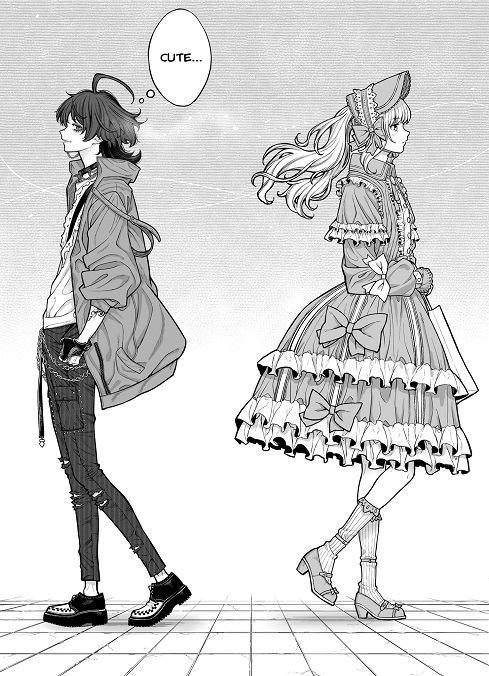
In context doesn’t get any better, the person here talking about Company and Private Life, a newly licensed manga about two office workers who dress up on the weekend: she as a punk girl, he in Lolita dresses. As the title hints, it’s about that contrast between how people dress and behave at work and in their private lives. It’s a nice little series by Kanazawa Shinnosuke about two co-workers who accidentally meet outside work when they literally run into each other in their weekend dress. Not knowing who the other “really” is, they strike up a friendship as their alter egos. So far it’s not really been romantic, at least in as far as it has been scanlated, but they did reveal themselves to each other in the latest episodes.

Is this a queer story?

Yes, in so far as it has the two leads being more comfortable in gender non-conforming clothing. She in butch punk outfits (torn jeans, t-shirts, leather jacket, gothic make-up, shortish hair), he in Lolita fashion (frilly dresses, blonde wig). But that’s all it has so far. There isn’t anything there that shows that dressing up this way is more than just a hobby for either of them, something they can do in their free time with no desire to do it full time. Ultimately this is still a hetero love story, not really a queer one, right?

The gothic lolita wearing Kanade-san fits in a long tradition of manga and anime boys cute and pretty enough to pass effortlessly as girls when they put on a dress, for whom putting on a dress is driven by little more than wanting to wear cute clothing. It’s very rare that any of these characters comes even close to being trans; dressing up is just a hobby, not something that they want or need to do to become their proper gender. Punk girl Aki-san too isn’t dysphoric or wanting to be seen as a man; she just likes her look and to be honest, you’d probably perceive her as female if you met her in real life. She looks a bit androgynous but not that much.

To think then that this is somehow more queer than having either be trans or having it be a lesbian romance (or both!) is just objectively wrong. Thinking that it’s groundbreaking to have a “feminine boy not be gay or trans” is absurd when these are actually the norm in manga and anime. Getting upset that some people would rather have a trans or lesbian romance instead is just plain silly. spend your energy on better things.

Anime I’m Still Watching This Season

In alphabetical order here are the shows from this season I’ve kept watching weekly. Which ones are you watching?

2.5 Jigen no Ririsa is your most basic of otaku bait romcom shows. Our protagonist is only interested in fictional woman until a girl enters his manga club who loves cosplaying his favourite character so he becomes her photographer. Not only that, there’s also a famous teenage model who is his childhood friend and is in love with him. Very much a lesser sort of My Dress-Up Darling.

Bye Bye, Earth: Lablac Belle is the only one of her species in a world of intelligent animals, lacking fur, scales or fangs unlike everybody else. She wants to find her roots but has to overcome all kind of challenges to even be able to start her journey. While the plot is a standard sort of ‘hero’s journey, what sets this apart is how dense and interesting the world is as well as how uninterested the series is in explaining it to you. A breath of fresh air after years of (pseudo-)isekai shows insisting to tell you what an adventure guilt is and how the ranking system works in their very first episode.

Dungeon no Naka no Hito. As Clay is busy conquering the dungeon her father disappeared in, she accidentally breaks one of its walls revealing a bed room? Turns out the monsters in the dungeon are its employees and the dungeon’s caretaker is eager to recruit Clay to help her run the dungeon. This is basically Dungeon Keeper: the workplace comedy.

Elf-san wa Yaserarenai.. Various fantasyland creatures have moved to our world and are now having trouble keeping their figure amid all the temptations of modern Japan. Luckily diet expert and massage therapist Naoe-kun is there to help. A half length fetish show with half naked elf and orc women trying to lose weight and failing. The manga is better but I’m not proud.

Giji Harem. Rin is the star actress of her high school drama club. Eiji is her senpai, working behind the scenes doing the set design and building. They quickly become friends and one day as Eiji bemoans his lack of a harem, Rin starts acting out various harem anime archetypes for him. That’s the hook but what keeps me watching is the gradual deepening of their relationship and Rin’s giggles of pleasure when she’s having fun with her senpai.

Gimai Seikatsu. Yuuta and Saki are classmates but then their parents remarry to each other, leaving them siblings. Warning signs usually start flashing at this point as you’re preparing fro some thrashy pseudo-incest, but instead this sofar has been a thoughtful, interesting series about two strangers learning to live together. I fully expect some sort of romance between them before the series is over, but it will be earned.

Hazure Waku no “Joutai Ijou Skill” de Saikyou ni Natta Ore ga Subete o Juurin Suru made. Just from the title you know it’s another thrash isekai show and you are right. Protag-kun’s whole class is summoned to another world to play hero for a manipulative goddess but he’s thrown into a dungeon from which no escape is possible for his thrash powers. Go to the head of the class if you already knew he’s actually overpowered and emerges from the dungeon out for revenge. I liked the manga version of this and the anime is decent enough to follow, though done in a weird mixture of 2D and 3D animation.

Katsute Mahou Shoujo to Aku wa Tekitai shiteita: the sub boss of an evil organisation falls in love with the magical girl opposing them. Hilarity ensues. By Studio Bones, this is a gorgeous looking half length show.

Koi wa Futago de Warikirenai: Jun is childhood friends with twin sisters Rumi (sporty, romantic) and Naori (intellectual, nerdy). After Rumi dates, then dumps him at the end of the first episode it’s Naori’s turn for the second episode, after which the series settles in a deliberately manipulated romantic triangle between the three of them. Fun little show and it won my respect when in an earlt episode Naori’s skirt was blown open by the wind, Jun got a handful but we as viewers did not.

Madougushi Dahlia wa Utsumukanai. Reincarnated after dying of overwork, Dahlia is a magical tools engineer now, having started her own business after her father passed away and her fiancee broke off their engagement. Slightly stiff animation but a beautiful setting and the promise of romance makes this worth watching even if the setup is a bit cliched.

Make Heroine ga Oosugiru!: an ordinary boy gets involved with various losers of a romcom love triangle as they struggle with what to do now. Funny but also suprisingly touching at times. Also one of the most gorgeous looking and animated series this season.

Mayonaka Punch: cancelled Youtuber teams up with a vampire coven to get famous again, after which the head vampire gets to drink her blood. Great characters, great animation and great sense of humour.

Na Nare Hana Nare: six girls from different high schools come together to do cheerleading together. A bit uneven and eight episodes in it’s still unclear where this is heading, but on an episode by episode base this always puts a smile on my face.

Shikanoko Nokonoko Koshitantan. The most hyped series of the season but this is isn’t as good or funny as the hype would have it. It relies a bit too much on SHOUTING as humour.

Shinmai Ossan Boukensha, Saikyou Party ni Shinu Hodo Kitaerarete Muteki ni Naru: Rick used to be a clerk for the Adventurers Guild but two years ago quit to become an adventurer himself, despite his low innate abilities. Having been trained by the most powerful team in the world, he has taken his license exam and is now on a fetch quest with them for a certain set of jewels. One of the series where the initial premise is quickly made irrelevant for a more generic plot. I do like that one of the stereotypical early bullies he needed to defeat to become a real adventurer returns to be an ally in his quest, having realised his strength.

Shoushimin Series: Kobato and Osanai want to be normal teenagers, but keep getting dragged into mundane mysteries nevertheless. Based on novels by the same author as Hyouka. None of the characters in this really convince as actual people and the various mysteries are incredibly dull but somehow it works. The care and attention given to the animation here by CloverWorks helps.

Shy: Tokyo Dakkan-hen: second season about the superheroine who is indeed as shy as her name implies. If you liked the first one you’ll like this as well.

Tokidoki Bosotto Rossiya-go de Dereru Tonari no Alya-san. Alya likes Kuze but is embarrassed to show it, so only says it in Russian. Little does she know Kuze can actually understand her. A fairly straightforward romance series that also wants to say something about the pressures family can put you under, Kuze having noped out of being the heir to his prestigious maternal family, leaving his little sister to take up the burden. She’s also in his school, masquerading as his childhood friend. Cue misplaced rivalry with Alya. I would like this better if Alya, supposedly highly capable, was allowed to do more and not had to be rescued every time by Kuze.

VTuber Nanda ga Haishin Kiriwasuretara Densetsu ni Natteta: when vtuber Kokorone Awayuki accidentally forgets to turn off her stream after she signs off and proceeds to get drunk and rant while still streaming, it becomes the breakthrough in her career she needed. The gap between her usual polite, sweet persona and foul mouthed ‘real’ nature proves to be irresistible. Fun for everybody who, like me, fell in the vtuber rabbit hole during the Covid pandemic.