That time Superman became a citizen of every country in the world

that day that Superman became a citizen of every country in the world

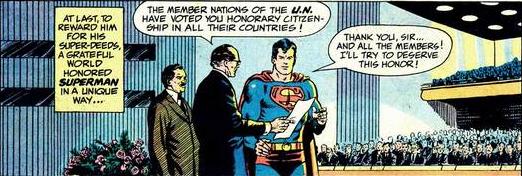
In Action comics #900, Superman renounces his American citizenship. Entitled rightwing crybabies respond in the mature way you expect them to by vowing to never again read comics they weren’t reading anyway. Little do they know Superman, way back in 1974, already got citizenship in every country in the world, including Red China, Communist Russia, North Korea, North-Vietnam, Cuba… Scans_Daily has the whole story. Truth, Justice and the Communist Way, amirite?

(Seriously, all the fucknozzles who get their panties in a bunch about this plotline would really shit a brick if they knew what a socialist Kal-El was back in the day, slapping around profitering landlords and such.)

It’s Hugo time again

Earlier this week the Hugo Award nominations were announced and the category I’m primarily interested in, Best Novel, is okay but not great:

Blackout/All Clear by Connie Willis (Ballantine Spectra)
Cryoburn by Lois McMaster Bujold (Baen)
The Dervish House by Ian McDonald (Gollancz; Pyr)
Feed by Mira Grant (Orbit)
The Hundred Thousand Kingdoms by N.K. Jemisin (Orbit)

Interestingly enough four out of the five nominees are women, something that hasn’t happened too often. So far I’ve only read The Hundred Thousand Kingdoms, but have both Cryoburn and The Dervish House on the to-read pile. Was I forced to vote, I’d go for the Jemisin (one of the best books I read last year and a very strong first novel, followed by the McDonald and the Bujold — but knowing how much the Hugo voters like Willis, she seems a safe bet to win this category.

It being Hugo Award time again, of course it’s also time for the semi-annual Hugo Award bitchfest, as online fandom once again berate the voters for being out of touch and exclusive. This time there has been a small storm brewing over the fan categories:

But don’t even get me started on the Best Fanzine and Best Fan Writer awards. Maybe I’m exposing my ignorance here, but beyond StarShipSofa, I haven’t heard of a damn one, nor am I familiar with any of the writers. My beef, obviously, is the lack of presence of blogs, bloggers and online writers. Where’re the Nialls (Harrison and Alexander)? Where’s Abigail Nussbaum or Adam Whitehead? No nod for SF Signal? Really?

James Nicoll, nominated for the second year in a row for best fanwriter (congrats!) was quick to put Aidan Moher right: “Apparently the net is large enough for us not to have run into each other in the 25 years I’ve been online + however long you’ve been online“… Most of the nominees Aidan complained about were online and had been online for years, if they hadn’t always been online — that he didn’t know them was an indication of how big online fandom has become.

Setting that aside, there remains the more general complaint about the out of touchness of the Hugo voters, as echoed in comments by Jonathan M: Hugo voters tend to be older and not too involved in online fandom and generally are conservative in their choices, much of which I agree with.

The problem with the Hugo Awards is that they were established in a time when science fiction and fantasy were much smaller and the fan commmunities build around them even smaller, a time when it was probably possible to know every active fan in the world. They got their prominence when it was still possible to read every word of science fiction published in English in a given year and when it was true that the Hugo voters were the sf and fantasy community.

This hasn’t been true for decades now, but the Hugos, as the oldest still existing awards in the genre, retain their standing even when the community that votes on them has become less and less representative of fandom as a whole, if you can still even speak of fandom this way. You can be an active, happy and well connected fan and never ever know about worldcons, Hugos, fanzines and old skool fandom at all, just like many Hugo voters happily putter around the same small world of their fandom.

All of which doesn’t really matter if not for the fact that the Hugos are the most important award in science fiction and fantasy still — if they’re out of touch and conservative, they’re worthless. I’m not certain this point has been reached already and certainly in the fan categories there has been somewhat of a renaissance the last few years — James Nicoll may be know in traditional fandom, but his fanac is as untraditional as you can get. Being ignorant of the nominees does not necessarily mean the awards are at fault; as said fandom is big enough that this will quite often be the case.

If people do want to reform the Hugos they need to put money where their mouth is and buy a supporting membership of this year’s Worldcon to get involved. At fifty dollars (about .5 euros in real money) this is a significant barrier to entry in these economic depressed times, I agree, but it’s the only way to change them as the organisation behind the awards, the World Science Fiction Society can only change the awards if their members want it. Online kvetching won’t change that.
Racism in cartoons should worry us all

Tom Spurgeon on racism in how Obama is portrayed in cartoons:

We unfortunately live in a society with no shortage of avenues for cultural assault on people of color. As this sucks far worse for people of color than it does for people looking for an apt, appropriate visual metaphor shorn of history’s crud, I have no problem expecting people not to employ them, or to be sorry when they do. I refuse to believe it’s impossible to recognize the nature of many of the most troubling images, and to draw a line between imagery with a recognizable rhetorical legacy and those that fall into more traditional realms of caricature and exaggeration and point-making. In fact, recognizing the first strengthens one’s stand on the second. Acting that this kind of thinking is some sort of bizarre imposition contributes to the problem, and ultimately that problem becomes bad cartooning and lousy discourse. If you want to use some loaded piece of visual shorthand, that’s fine — but you should own it. One hopes that our cartoonists and thinkers about cartooning at the very least recognize the more obvious tropes for what they are — unnecessary, unfair, and ultimately a distraction from actual points being made on more concrete issues.

The trouble of course is that the people most likely to use racist imagery to criticise Obama are also the ones least likely to see any problems with that. There’s a lot of innate racism seeping out in the rightwing opposition to Obama which has troubles seeing any Black people as true Americans, hence the Birtherism, hence the racial stereotypes and hence the Obama caricatures that get their imagery more from those stereotypes than from how Obama (and his wife) actually looks. The people most likely to draw or distribute such cartoons as Tom talked about cannot be reasoned with — any hope of them owning their racist tropes is I fear forlorn. Instead the comics community as a whole needs to call people on their shit.

Which we haven’t been doing enough of. It’s always tempting to think of these things as business as usual, partisan politics in which nobody is innocent, of little intrisic interest to the comics blogosphere unless they become a media controversy, as when James Hudnall and Batton Lash were called out for their portrayals of Obama. Even then the emphasis was on the death threats they recieved, rather than on the racist imagery in their cartoons. That whole incident showed how ingrained our reflex is to circle the wagons whenever outsiders attack comics, rather than take a step back and see if they have a point.

fiawol/fijagh/gafia

Dave Lartigue is sick to death of “nerd culture”:

I am tired of zombies. I am tired of Joss Whedon. I am tired of steampunk. I am tired of Monty Python. I am tired of zombies. I am tired of ninjas. I am tired of Batman. I am tired of bacon. I am tired of Star Wars. I am tired of Nintendo. I am tired of zombies. I am tired of Halo. I am tired of elves. I am tired of Cthulhu. I am tired of Boba Fett. I am tired of zombies. I am tired of pirates. I am tired of Battlestar Galactica. I am tired of mecha. I am tired of superheroes. I am tired of Star Trek. I am tired of “funny” bands. Have I mentioned that I am tired of zombies?

Dave himself is of course as guilty as any other nerd of the excesses of nerd culture — Write More Good e.g. — and his post is part of a larger wave of nerd anxiety that regularly courses through various fan communities that is as old as the concept of geekdom as a coherent community itself. As such I think it would be enlightening to look at three concepts from science fiction fandom, one of the oldest clusters within this community: fiawol, fijagh and gafia.

Science fiction fandom quite early on realised that there is an inherent tension between people for whom fandom is a way of life and behaved accordingly, the be and end all of their lives and for whom fandom is just a goddamn hobby, no more or less so than e.g. going out bowling with your workmates, with most fen hovering between these two extremes. This tension is unresolvable, is different for everybody, but will lead a lot of people to gafiate: get away from it all. And there’s nothing wrong with that. Indulge yourself too much in almost anything and you get sick of it; spend some time doing something else, recharge your batteries and you can come back refreshed or you realise that you don’t actually need it anymore. Either way you win.

Trying to change the wider nerd culture because you don’t like certain aspects of it (mashups, bacon, obsessive quoting, bacon, undsoweiter) is a mug’s game. It’s only worthwhile when you’re trying to change genuinely toxic aspects of it, as with the whole racefail “debate” of a few years ago. The rest is only a matter of personal taste where you always have to remember that no matter how played out, tired and boring something is to you, it’s always somebody’s first exposure to a particular idea/meme…

What postal liberalisation has done to us

Three key paragraphs out of James Meek’s excellent LRBarticle on post office privetisation in the Netherlands and the UK:

Somewhere in the Netherlands a postwoman is in trouble. Bad health, snow and ice and a degree of chaos in her personal life have left her months behind on her deliveries. She rents a privatised ex-council flat with her partner and so many crates of mail have built up in the hallway that it’s getting hard to move around. Twice a week one of the private mail companies she works for, Selektmail, drops off three or four crates of letters, magazines and catalogues. She sorts and delivers the fresh crates but the winter backlog is tough to clear. She thinks her employers are getting suspicious. I counted 62 full mail crates stacked up in the hall when I visited recently. There was a narrow passageway between the wall of crates and her personal pile of stuff: banana boxes, a disused bead curtain, a mop bucket. One of the crates has crept into the study, where the postwoman’s computer rears up out of her own archival heaps of newspapers and magazines. Should these two streams of paper merge they would not be easily separated. The postwoman hasn’t given up. She had a similar problem with the other private mail company she works for, Sandd, a few years back. ‘When I began at Sandd in 2006 I delivered about 14 boxes of mail every time,’ she said. ‘I couldn’t cope and at Christmas 2006 I had about 90 of these boxes in the house. By New Year’s Day we had 97. There were even boxes in the toilet.’ The postwoman is paid a pittance to deliver corporate mail. She hasn’t done her job well, yet so few people have complained about missed deliveries that she hasn’t been found out.

[…]

Every week Dutch households and businesses are visited by postmen and postwomen from four different companies. There are the ‘orange’ postmen of the privatised Dutch mail company, trading as TNT Post but about to change their name to PostNL; the ‘blue’ postmen of Sandd, a private Dutch firm; the ‘yellow’ postmen of Selekt, owned by Deutsche Post/DHL; and the ‘half-orange’ postmen of Netwerk VSP, set up by TNT to compete cannibalistically against itself by using casual labour that is cheaper than its own (unionised) workforce. TNT delivers six days a week, Sandd and Selekt two, and VSP one. From the point of view of an ardent free-marketeer, this sounds like healthy competition. Curiously, however, none of the competitors is prospering. TNT is being forced by the hedge funds and other transnational shareholders who control its destiny to split up, even as it tries to beautify its bottom line by replacing reasonably paid jobs with badly paid ones. Deutsche Post is pulling out of the Netherlands and selling Selekt to Sandd – a company that has never made a profit.

[…]

Van Hulten, who is 81, is still an activist, an idealist. The privatisation of the mail depresses him; the latest privatisation, of Holland’s local transport networks, makes him angry: the three bus companies supposedly competing in Lelystad, he said, are all owned by the same French firm. ‘Today’s Wednesday, yeah?’ he said. ‘On Wednesday, we have at least six people coming to the door, all bringing some mail. First was the local paper. Then the other local paper. Then the postman comes. Three more will come later. I think that’s the basic defect of post office privatisation. What used to be done by one man is now done by six. They’re all underpaid, and the delivery hasn’t improved. It used to come in the morning, and now I’m still waiting.’

Privatisation and competition in the mail market has literally had no positive effect whatsoever in the Netherlands. For the workers it has meant increasing casualisation, the increasing shedding of good jobs and the replacement by piecemail work that does not pay a living wage. For customers, both sending and recieving, it has meant a much less reliable postal service with post arriving later than we’re used to and less often than we were used to. For the companies themselves, it hasn’t even meant profits, almost as if companies like Sandd or Selectmail were founded just to force through this process of casualisation. Only the Dutch Post/KPN/TNT/TNT Post has been able to profit, making more money with less workers than using these profits to buy out other companies rather than do anything useful with it, in an orgy of supposed creative destruction. That sort of thing keeps the board of directors and their consultants in ready money, sometimes even the shareholders, but it kills everybody else. To add insult to injury TNT last year threatened its workers with mass redundancies unless they agreed to an (iirc) 15 percent pay cut. They lost that fight, but the trend is clear.

A run of the mill story of capitalist betrayal, but in TNT’s case it hurts me more because I used to work for the fsckers, back when being a postal worker still meant something, even if like me you only did it on Saturdays to get me through college, or rather fuel my comix habit. That was when even a parttime job with the post office paid well and people who came with nothing but a willingness to work hard and no adversion to starting early could get into a job that offered good pay and safety for years if not decades, without having to worry about having a proper career. I spent my Saturdays with men and women who had done their rounds for ten, twenty, thirty years and still liked the work, even though the first grumblings at the changes the socalled free market demanded had appeared. These days, who would want to be a postman if it means hard and increasingly harder, dumb, unappreciated work delivering unwanted junk mail slightly cheaper for big multinationals and be paid below minimum wage?

Market reform at the post office has destroyed or is destroying one of the proudest bastions of the working class, has destroyed a whole system of jobs open to anyone, not just to people with the right university papers and a business driven attitude. This is not a coincidence.