A premature Spark

Spark Publications was a very short lived comics publisher, lasting from December 1944 to June 1946 and only managing to put out fifteen issues of three titles in that period: two issues of Atoman, eight of The Green Lama and five of Golden Lad. As the names indicate, all three were superhero titles just as the market for them was crashing as comics readers moved on to other genres like true crime and romance. They never had a chance in the cutthroat competition of what we now call the Golden Age of American comics. Spark in other words was just a footnote in American comics history, barely remembered and rarely mentioned even in fan histories.

So why do I bother with them now? Because thanks to the internet and especially the crazy obsessed comics fans over at the Digital Comic Museum even such minor footnotes to the Golden Age are now archived and preserved and sometimes you find real gems in them. In Spark’s case, they turned out to employ three of the very best Golden Age artists: Mac Raboy on Green Lama, Jerry Robinson on Atoman and Mort Meskin on Golden Lad. What’s more, these are artists with a similar style and they give Spark Publications a much more unified look than most publishers had in the Golden Age, a sort of unconscious housestyle.
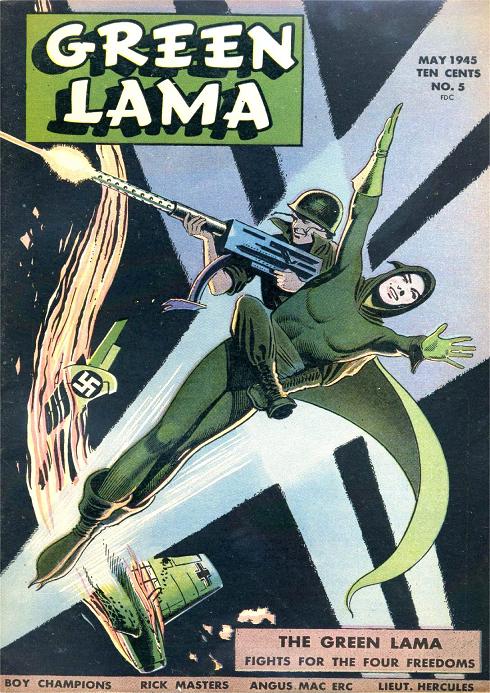
Cover to Green Lama #5

Mac Raboy is best know for his work on Captain Marvel Jr. for Fawcett. His linework and composition was always elegant, even fey, which works well on the Green Lama, certainly not your typical musclebound hero. Especially his covers, like the one above or this one for issue four are masterpieces of style and elegance. His interior work is weaker, not as good as that of Robinson or Meskin, but still head and shoulders above your average Golden Age artist.
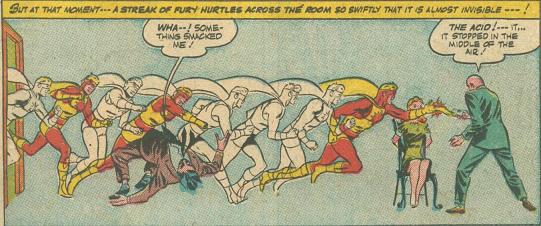
a panel from Atoman #1

Jerry Robinson is the man who invented the Joker, even if Bob Kane took all the credit for it. Robinson had a long career at DC, but during the Golden Age also worked for other publishers, like Nedor/Standard/Best, often together with Mort Meskin. His work for Spark came after five-six years spent honing his craft and it’s noticable in everything. His art, as in the panel above just oozes confidence. That superimposing of images to show speed here is a bit of sophistication you don’t see often in Golden Age comics, not even by acknowledged masters. And it’s done in an interior panel to serve the story, rather than in a splash page or cover.
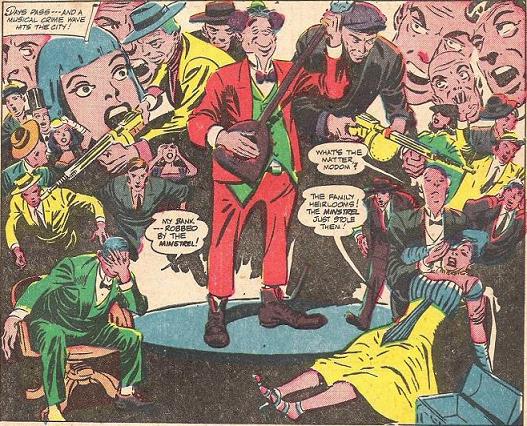
a panel from Golden Lad #4

Mort Meskin is probably the best of these three artists, criminally underrated and who never quite got the recognition he deserved. No wonder he fled into advertising later in life. Everything I’ve ever seen of him I’ve loved; I’ve never seen him draw a bad comic. What struck me here is how Ditkoesque this looks, with the floating outraged faces and the slightly rubbery anatomy of the central figures.

Coincidence or not, these three artists all have a similar style, one that stresses elegance and clarity of line above raw expression and it makes their heroes look like they belong in the same universe, an early example of what Marvel would later consciously do with their house style. Spark Publications never amounted to much, but the fifteen comics they put out are well worth a look — and thanks to the Digital Comic Museum you can.

Toell the Great


Strange Soviet era Estonian animation of an old Estonian legend, found via the comments section of the War Nerd of all places. Supposedly caused a few children nightmares when it was originally shown, which I can well imagine…

Aah Humbug

For some reason the English remaindered bookstore at the top of Kalverstraat has not just been well stocked with comics trades and hardcovers –I managed to snag some forty Marvel Essential collections there– but with Fantagraphics’ published books. Over the years this has enabled me to buy a hell of a lot of books I could’ve never afforded at full price, the latest example being the beautiful hardcover slipcase collection of Humbug. Originally published at sixty dollars and with Dutch comics prices usually translated one for one dollars into euros, it was now a steal at twenty euros — and they still have some copies left.

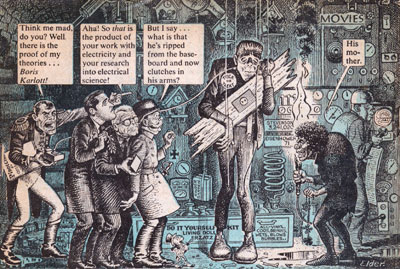
An example of Humbug. Art by Will Elder

Humbug was Harvey Kurtzman’s second attempt at creating a new, improved Mad, after the Playboy published Trump, a slick expensive full colour magazine that only lasted two issues before Hefner pulled the plug. Somehow Kurtzman managed to persuade his collaborators — Will Elder, Jack Davis, Al Jaffee, Arnold Roth and Wally Wood (but only for the first issue)– to try again, but this time be their own publishers. The end result was Humbug, much more political and grownup than Mad or Trump ever were, but again not commercially succesful, which meant it folded after eleven issues. Kurtzman would try one last time, with Help, which lasted slightly longer: twentysix issues.

To say that this is a handsome collection or that this contains some brilliant satire by cartoonists at the peak of their power is to state the obvious. So let’s not. More interesting is what it feels like to finally hold a collection of such a legendary comics in your hands after having read about it for years, if not decades. These comics had been out of print since the late fifties, with the only way to see even a glimpse of them through reading books on comics history. For me, it was Les Daniels’ early seventies book Comix: A History of Comics Books in America that gave me that first look, together with so many more other classic comics books that I never would be able to see in their complete form, because who was going to reprint these ancient and almost forgotten treasures?

It’s only been the last decade or so that there have been enough publishers mining American comics history that you can be certain almost everything of any interest has been or will be reprinted. But that was not the case when I first got into yankee comics and for most stuff the only realistic option was to read about them, rather than read them. Having something as wonderful as a hardcover reprint of Humbug, something I’ve read about for decades, still amazes me.

The Gollancz fifty

This year it will be fifty years since Gollancz started publishing science fiction and fantasy. To celebrate the publisher set up a website listing its fifty best science fiction and fantasy novels (or at least the ones it still has the rights to) and is asking us, their readers to chose our favourites out of these. Twentyfive science fiction and twentyfive fantasy novels are listed and you get to choose one of each. The top five choices will be published in a special “collectable retro-look edition”. A nice idea to celebrate a very important British science fiction and fantasy publisher. I can’t be the only fan who quickly learned to associate yellow covers in the library’s bookcases with proper science fiction….

Given that these lists had to be created out of the books Gollancz still had the rights to, they’re somewhat biased towards contemporary authors, but unfortunatly also heavily biased towards male authors: of the twentyfive science fiction novels, only two are by women. The fantasy list is slightly more balanced, but still only has five novels written by women. Both lists are also very white and anglosaxon. Of course you can argue that given the constraints of having to work from their own backlist meant that these lists would always be imbalanced, but than that only moves the argument to why Gollancz hasn’t had a more diverse publishing list in these fifty years…

Apart from that, these lists are a good excuse to play the usual “bold if you’ve read it, italicise if you own it” game. First the science fiction list, which seems to be the stronger of the two and from which I’ve certainly read the most. On the downside, there are no real surprises in this list either: a mix of obvious classics always present in these lists and contemporary bestselling authors. Many of these books have had special editions recently as well, e.g. in the Science Fiction Masterworks series. Which probably explains why I read so many of them…

  • A Case of Conscience by James Blish
  • Altered Carbon by Richard Morgan
  • Brasyl by Ian McDonald
  • The Dispossessed by Ursula Le Guin
  • Do Androids Dream of Electric Sheep? by Philip K. Dick
  • Dune by Frank Herbert
  • Fairyland by Paul McAuley
  • The Female Man by Joanna Russ
  • The Forever War by Joe Haldeman
  • Flood by Stephen Baxter
  • Flowers for Algernon by Daniel Keyes
  • Gateway by Frederik Pohl
  • Hyperion by Dan Simmons
  • Last and First Men by Olaf Stapledon
  • More than Human by Theodore Sturgeon
  • Pavane by Keith Roberts
  • Rendezvous with Rama by Arthur C. Clarke
  • Revelation Space by Alastair Reynolds
  • Ringworld by Larry Niven
  • Stand on Zanzibar by John Brunner
  • Tau Zero by Poul Anderson
  • The Time Machine by H. G. Wells
  • The Separation by Christopher Priest
  • The Stars My Destination by Alfred Bester
  • Yellow Blue Tibia by Adam Roberts

The fantasy list seems to be more heavily biased towards contemporary books, with some odd choices: the complete Book of the New Sun but Stephen R. Donaldson is represented by the first book of the third trilogy in the Thomas Covenant series? Why Eric of all Discworld novels?

  • Beauty by Sheri S. Tepper
  • Best Served Cold by Joe Abercrombie
  • Book of the New Sun (Vol 1&2) (Vol 3&4) by Gene Wolfe
  • The Book of Skulls by Robert Silverberg
  • Conan Volume One by Robert E. Howard
  • Dead Until Dark by Charlaine Harris
  • Elric by Michael Moorcock
  • Eric by Terry Pratchett
  • Fevre Dream by George R. R. Martin
  • The Final Empire by Brandon Sanderson
  • The Forest of Hands and Teeth by Carrie Ryan
  • Graceling by Kristin Cashore
  • Heart-Shaped Box by Joe Hill
  • I Am Legend by Richard Matheson
  • The Lies of Locke Lamora by Scott Lynch
  • Little, Big by John Crowley
  • Lud-in-the-Mist by Hope Mirrlees
  • Memoirs of a Master Forger by William Heaney
  • Mythago Wood by Robert Holdstock
  • The Name of the Wind by Patrick Rothfuss
  • The Runes of the Earth by Stephen Donaldson
  • Something Wicked this Way Comes by Ray Bradbury
  • Tales of the Dying Earth by Jack Vance
  • Viriconium by M. John Harrison
  • Wolfsangel by M. D. Lachlan

I’m not sure which books of either list I’d choose as my favourite, but I’d think in the end I’d go for Stand on Zanzibar and Mythago Wood, both books by British writers who died too soon and who deserve a bit more attention.

Fake charity

advert for Kika bracelets

At Unfogged they’re annoyed at the juvenile I Love Boobies anti-breast cancer campaign both for its inherent sexism and it’s misguided focus on outdated detection methods. Coincidently, yesterday I got annoyed at a similar sort of charitable campaign at the local hospital S. is staying in (until tomorrow). As you can see from the picture above, in the public canteen they’re now selling these anti-cancer bracelets to benefit Kika. Kika, which stands for “KInderen KAnkervrij” or “children cancer free” is a charity that sponsors research for combatting cancer in children and which supports the seven cancer centra that do this sort of research in the Netherlands. A worthwhile cause and there’s nothing wrong by supporting it by selling some token of compassion for it — unless it costs twelve euro fifty of which only one euro goes to the charity it supposedly supports!

Because that sounds remarkably like using this charity to get rid of the cheap tat you cannot sell on its own merits.