Some links to comics blogs you can’t read anyway*

Dutch cartoonist Jean-Marc van Tol, off off Fokke & Sukke fame, has started a series of Youtube comics reviews, possibly as a warmup for Beeldverhaal, his new television series about comics debuting this October. He’s done entries on Rabaté, Willy “Urbanus” Linthout and Daniel Clowes’ Ghost World:


I agree with Michael Minneboo, that the calm but enthusiastic way in which Jean-Marc van Tol talks about comics is great and makes you want to run out and buy them immediately, even though I can’t stand Clowes at the best of times.

Another recent discovery is the blog of IJsbrand Oost, a relatively new cartoonist (to me at least) who works in a ligne claire style seriously influenced by Henk Kuijpers. As with Jean-Marc van Tol, here you have somebody who obviously understands his craft very well and –much rarer– knows how to explain it to you as well, as in the post in which he tells how he evolved his drawing techniques. These insanely detailed drawings turn out to be done directly on paper first, with the background, foreground and characters drawn separately, then scanned in and manipulated on the pc before being printed out and inked on heavier paper, with the colouring once again done on the computer. I love reading this sort of thing.
(* Except for Reinder, Branko and Michel)

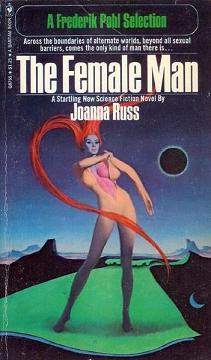
The Female Man — Joanna Russ

Cover of The Female Man


The Female Man
Joanna Russ
214 pages
published in 1975

The Female Man is the third book in my list of works by female sf authors I’ve set myself as a challenge to read this year. Of the books on the list it is the most explicitely feminist one, a cri de coeur of “second wave feminism”, a science fictional equivalent of The Feminine Mystique. Written in 1970 but only published five years later it was somewhat controversial, science fiction never having been the most enlightened genre in the first place. Reading it some thirtyfive years later it’s tempting to view it as just a historical artifact, its anger safely muted as “we know better now” and accept the equality of men and women matter of factly, its message spent as sexism is no longer an issue, with history having moved on from the bad old days in which The Female Man was written.

Bollocks of course, but seductive bollocks. The reality is that for all the progress made since The Female Man was published, its anger is not quite obsolete yet, or we wouldn’t have had the current debate about the lack of female science fiction writers in the first place. What’s more, The Female Man ill fits in this anodyne, whiggish view of history anyway. Russ is much more angry than that. She’s utterly scathing in her view of men in this novel, reducing them to one dimensional bit players: thick, macho assholes her much more intelligent heroines have to cope with. You might think this “hysterical”, “shrill”, “a not very appealing aggressiveness” but Russ is ahead of you and has included this criticism in her novel already, on page 141: “we would gladly have listened to her (they said) if only she had spoken like a lady. But they are liars and the truth is not in them.” Russ was too smart not to understand that no matter how non-threatening and “rational” The Female Man might have been written, (male) critics would still call it emotional and not worth engaging. But Russ uses her anger as a weapon and tempers it with humour and some of the angriest, bitterest scenes are also grimly witty.

Read more…

Books read March

Seven books read this month, one of which was a monster of a history book which took up most of the month to read.

Propaganda — Edward Bernays
There is nothing new under the sun, as this *ahem* propaganda pamphlet on the positive uses of properly directed propaganda in business and public life, first published in 1928, shows. Bernays was one of the founders of the “science” of public relations, active in helping the US government prepare the American public for the Great War and here he justifies his profession. The introduction by Mark Crispin Miller is helpful in setting out the context for Bernays’ book.

Empires of the Sea — Roger Crowley
For about sixty years the Ottoman Empire fought for mastery of the entire Mediterranean against a on again off again coalition of Christian states, from 1520 and the Siege of Rhodes to 1580 and the Battle of Lepanto where the Ottoman fleet was decisively defeated. Classic narrative history here, a good introduction to an important and interesting part of European history.

Ashes of Victory & War of Honor — David Weber
I got myself a new Android phone in late January and got the Kindle ebook app for it early in March, so I decided to download some David Weber for it as a test of whether or not reading books on a mobile actually worked for me — two novels later, I say it did.

Winterfair Gifts — Lois McMaster Bujold
Another Kindle book, a Miles Vorkosigan story I had not read yet. Set after A Civil Campaign, it’s told from the point of view of one off Miles’ armsmen as he witnesses the preparations for Miles wedding. A bit of emoporn for Vorkosigan fans.

Framing the Early Middle Ages — Chris Wickham
An excellently written and researched, very thorough socio-economic history on the transformation of the world of the Roman Empire into the world of the Middle Ages. It’s not the definitive answer to why the Roman Empire fell or why the transformation from Roman to post-Roman Europe and the Medtiterranean happened the way it did, but he does try to frame those question in such a way that you understand that this process was not predetermined, trying to avoid the teleological trap of wanting to write history in terms of its outcomes.

The Female Man — Joanna Russ
A classic feminist science fiction novel, which I read for my Year of Reading Women project. This is one of those novels every science fiction fan should at least try to read to be knowledgable about the genre. It’s also quite good.

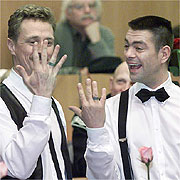
Ten Years of gay marriage — Holland still not washed away by the tears of an angry god

picture from the World's first gay marriage

You think what with the monotonous regularity God strikes immoral countries, at least according to Yankee fundamentalist wankers, Holland would’ve long ago been wiped out by a superflood/earthquake/volcanic eruption combination for being the first country to make gay marriage legally the same as “normal” marriages. Yet ten years later, we’re still here, gay people can still marry if they want to and no sign of any wrath of god yet.

One of the few times I’ve genuinely been proud of my country. No nonsense, no hysteria, just a (belated) recognition that yes, there is no reason why gender should matter in who you could marry. The only thing that mars it is that civil servants who have problems with performing gay marriages can refuse to do the work they’re paid to do. Ten years should be enough of that nonsense.

Five years ago.

Union support for UK Uncut

Further confirmation that the supposed gap between the great mass of lawfully protesting DecentOrdinaryFolk and the StudentRadicals of UK Uncut is not as great as certain career opportunists might want us to think, here’s a letter of support for UK Uncut signed by various union and NGO bigwigs:

UK Uncut have played a significant part in changing the terms of debate around economic policy in the UK and have been praised by politicians and the media for doing so.

Indeed UK Uncut played a key role in ensuring that more people were at the march on Saturday than otherwise would have been. At all times they acted in a way which complemented and supported the TUC march.

However, in taking the type of peaceful action which UK Uncut routinely undertake on Saturday, targeting Fortnum and Mason on this occasion, they were treated in a political and deceptive manner by the police which sends an ominous message about the right to protest.

It would appear activists were misled by the police about not being arrested when asked to leave the Fortnum and Mason building, after which they were held for a significant length of time, their clothing was confiscated and they have been denied the right to protest in the near future.

This situation has now been seized on by the media and politicians to further threaten the right to protest. UK Uncut activists have been blamed for damage they did not cause and this story has become a substitute for discussion of the real issues raised by UK Uncut and the TUC march in general.