Saturday is music day

Here, have a video:


I hadn’t heard of Dearling Physique before, until Rydra Wong linked to it, but this is a great video and a good song too.

In more personal music news, last Tuesday, in the fifteen seconds between my ipod slipping out of my coat pocket and me noticing this and cycling back, some fscker must have spotted it and swiped it, as prolonged searching has gotten no result. It was only a 2GB mini ipod, once gotten as an incentive for going to a job interview I was reasonably sure I wasn’t actually going to accept if I got through, but it was my little friend and for now has left me musicless during my commute. Grumble.

Creeping back into Afghanistan

The government today announced that it would propose a new police mission in Afghanistan to parliament, even though it was this exact same issue that caused the previous government to stumble. But with the coalition partner (PvdA/Dutch Labour) that then objected now in opposition and the two parties that form the current minority government both having been firm supporters of the original proposal, it was just a question of time before it would be back on the agenda again.

At first view it looks innocent enough, to get some twohundred or so civilian cops to Afghanistan to help train the locals, but the devil is in the details. With them some 300 odd soldiers would be traveling back into Afghanistan as well, to provide security, support and liason duties with other NATO forces in the area. There would be four F-16 jets coming along as well, again to provide air support for this supposedly civilian mission. I can’t help but see this as the thin end of the wedge — once we have some fivehundred plus soldiers and cops stationed again in northern Afghanistan, it will become that much easier to extend and enlargen their mission and before you know it we’re creeping back into the war again. Which is something the current government parties, who didn’t agree with the end of the original Dutch involvement in the War in the first place, would not mind at all.

Ironically, the opposition against this proposal is likely to contain both Geert Wilders’ party and its fiercest critics, the PvdA and Socialist Party. The latter because it’s opposed in principle to any involvement, the former because it sees no good in letting “our boys” risk their skins for foreigners, especially when the government needs to cut spending on policing anyway and we need those cops on our streets….

Some links

Strange Horizons has put out their science fiction year in review and the interesting thing is: no mention of Iain M. Banks. Funny, for me Surface Detail was one of the best books I read this year, but no peep of it in SH’s list. Reviews elsewhere have been lacklustre as well, something that I’ve noticed before with the previous “new” Culture novels. It’s as if the original three novels have set expectations so high that everything that Banks has done afterwards is consciously or not compared to the impact the original trilogy had. Hardly fair, but perhaps inescapable.

Now for something completely different. We knew crows were clever, but they are even more clever than we thought. New Caledonian crows have long been known to use twigs to pry insects out of trees, but now experiments have proven that these crows know how to adapt their tools for multifunctional use by poking at a rubber spider with a twig. It sounds like nothing, but these are probably the first non-mammal species shown to have the mental capacity and creativity to not only use tools, but adapt them for other uses and, as the Wired article also notes, use them in sequence: using a twig to get a twig to get food. I’ve had co-workers who showed less promise…

Finally, would you like some cheese with that white whine?

More government bullying of coffeeshops

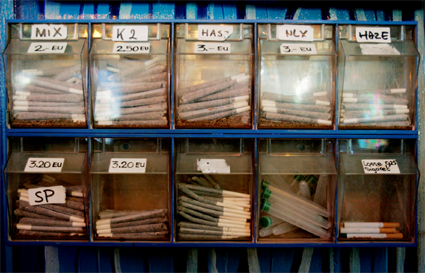
prerolled joints for sale

I’ve posted before about the “wietpas“, the current Dutch government’s attempt to slowly strangle the coffeeshops by depriving them of foreign customers, but that’s not the only measure they want to introduce. Another proposal doing the rounds right now is the idea to close any coffeeshop that’s too near a school, for the sake of the children of course. Exactly what is too near a school and which kind of schools will fall under this new proposal is still unclear. The only thing we know so far of the plans is that the governments wants to ban all coffeeshops in a range of 350 metres distance from a school, but not how this will be measured — as the crow flies, or based on the shortest route from a given school to a shop. That last measurement would probably the least harmful to existing coffeeshops, but even then almost sixty percent of coffeeshops in the Netherlands would have to close, according to the NRC newspaper.

They looked at the fourteen municipalities with ten or more coffeeshops within their borders, who together account for 442 out of the 660 shops in the country. Judging by the most positive interpretation of the proposed law, some 57,9 percent of these shops would have to close — in Amsterdam it would mean 187 out of a total of 223, including the world famous Bulldog. Combine that with the restrictions on selling to tourists and it would basically mean the end of the coffeeshop as we know it.

It’s an absurd measure, supposedly meant to protect children from the dangers of drugs, but the idea that teenagers looking for dope would bike 350 metres but not 351 metres to go to the coffeeshop is silly. What’s more, it’s already illegal for coffeeshops to sell softdrugs to people younger than 18 and the decent ones do check, as I know from my own experience. They have to, because if they do get caught selling to underage kids, it means they’ll lose their license and are barred from owning any coffeeshop.

Nobody, — coffeeshop owners, police, city councils, social workers or even the government themselves — thinks this measure will actually solve anything, especially considering the Netherlands is doing quite well already anyway, with one of the lowest addiction and hard drug use rates of any western country. The truth is that this government has an ideological hatred for soft drugs, partially from Christian moralism on the part of the CDA, partially from the “fact” that the pseudolegalisation of soft drugs in Holland is a leftwing legacy of “the seventies” and this government puts great pleasure in destroying “leftwing hobby horses” just for the sake of it.

Two more years of cuts and the Olympics — what fun!

As predicted by BBC Newsnight bod Paul Mason:

The Coalition will fall. Not because of protest, not because of unpopularity but because everytime it tries to do something serious a bit falls off the machine. If they don’t get AV and Vince Cable does not get radical banking reform, then by the time the public sector job losses are eating into their popularity, around party conference time, the Libdems will call it a day. Even more audaciously I will predict the outcome: no election but a Second Coalition to be formed between the Conservatives, an inner core of Orange Book Libdem leaders and various Unionists, with a slim majority. One or two Labour rightwingers, disgruntled by Ed Miliband, may also be tempted to join. Cameron will face down the Conservative right and embrace Coalition government as a modus operandi until 2015. Labour, locked in a policy review process and possibly still reeling from (8) above, will avoid an election.

Jamie had some fun with the second part of that prediction, but I want to look at the first part. Protests, especially in the UK, do not have a particularly good track record in bringing governments down, or even get them to change their minds, but the ConDems are more vulnerable than most, largely due to the Dem part of it and its internal contradictions. Even then, it’s hard to imagine protests, even ones as big as the 2003 anti-war protests, will do much to disrupt the coalition, other than to accelerate the weakening of the machine as Mason puts it.

However, there is the potential for a huge, embarassing clusterfuck to happen smack dab in the middle of the ConDem’s reign. I’m talking of course about the 2012 London Olympics, enthusiasm for which never was that high in the first place, which will make the perfect opportunity for anybody fed up with the coalition’s policies to show their displeasure in front of the whole world. BBC London News today reported that a large part of the success of the Vancouver Winter Olympics was due to the large number of well trained, friendly volunteers at the games — image what could happen if thousands of disgruntled students, jobseekers and other victims of ConDem policies decide to take to the streets during the London games…

What struck me was the contrast between what will be everyday life in England after two years of budget cuts, slashed social services and a crumbling social infrastructure and the attempt to turn London in the world’s largest potemkin village as the Olympics come to visit. Normally the general public is not keen on anybody who politicises the Olympics, but when many members of it will be victims of ConDemmed policies themselves, how will that change?