Fifty Essentials in Fifty Days 02: Man-Thing v1

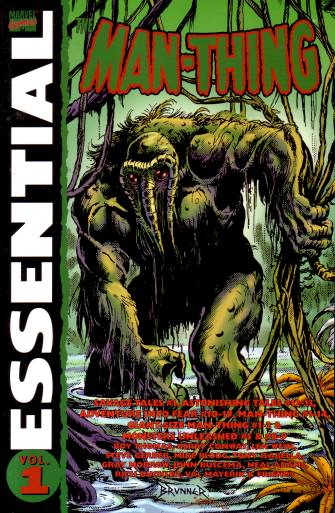
essential Man-Thing Vol. 1


Essential Man-Thing Vol. 1
Steve Gerber, Roy Thomas, Val Mayerik, Mike Ploog and Friends
Reprints: see below
Get this for: Gerber, Gerber, Gerber! — five stars

Right. Day two. Essential Man-Thing Vol 1 collects Savage Tales #1, Astonishing Tales #12-13, Adventure into Fear #10-19, Man-Thing #1-14, Giant-Size Man-Thing #1-2 (don’t snigger) and Monsters Unleashed #5, #8-9. It features writing and art of Roy Thomas, Gerry Conway, Tony Isabella, Mike Ploog, Val Mayerik, Gray Morrow and others, but is dominated by one man: Steve Gerber.

Man-Thing made his debut in May 1971, only two months before that other muck encrusted swamp monster, Swamp Thing over at the Distinguished Competition, more a case of tapping into the same zeitgeist as somebody copying somebody else. Whereas old Swampy still had a human intelligence under all that muck, Manny was less fortunate, with the man he was, Ted Sallis, yet another genius-scientist who became the victim of his own weapons, completely submerged, leaving him to react purely by instinct. In the first few stories this leaves Man-Thing to function as a deus ex machina, to pop up at convenient times to drive the plot. Once Gerber takes over the writing this role doesn’t change much.

The real difference is what kind of stories Gerber has Man-Thing resolve. He mixes in horror, absurdity, superheroes and a generous helping of seventies politics and soulsearching. At its worst this becomes an incoherent mess, but at its best this made Man-Thing one of the best things Marvel had during the seventies, something that was genuinely in touch with the times. This was of course also the series that introduced Howard the Duck to a largely befuddled world and you can see part of what Gerber would perfect with Howard already here.

With Man-Thing, what you have are stories that are only slightly more absurd than what you’d get in a normal Marvel series, with villains who are largely buffoons: a corrupt businessman called F. A. Schist (subtle Gerber ain’t), a Cult worshipping Entropy, a Suicided clown replaying his life using Manny and co as his puppets and so on. They’re not that different from the fools you’d see fighting Spider-Man or the Fantastic Four elsewhere, just slightly more amplified. With Manny himself a mute, mindless observer of what’s going on in his own book, only reacting to what people are doing to him, it’s the normal people in his supporting cast who are the real protagonists, especially one Rich Rory, somebody Gerber would uses elsewhere as well.

Absurdity in superhero comics has a bad reputation, because most writers just go for mindless parody. With Man-Thing, you have the absurd (having a warrior prince from another dimension metamorphose out of a peanut butter jar for example) dealt with matter of factly, without the wink-wink nudge-nudge of lesser titles…

Most of the artwork in this volume is by Val Mayerik, somebody I’ve always liked. Unfortunately the lack of colour seems to have zapped some of the vitality of his art here; it all looks a bit pedestrian. But then Mike Ploog takes over and his slightly cartoony yet slick style works quite well in black and white. There’s some great work by other artists as well, including John Buscema and Gray Morrow.
Fifty Essentials in Fifty days 01: Dr Strange v1


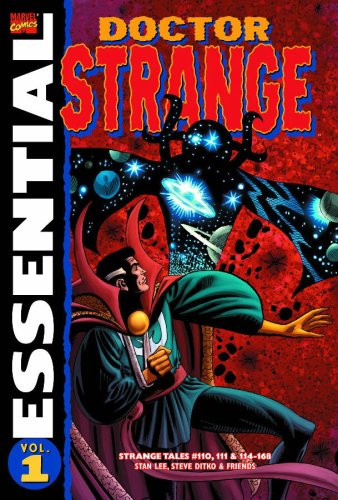
Essential Dr Strange Vol. 1
Stan Lee, Steve Ditko and friends
Reprints Strange Tales #110, #111, #114-168 (August 1963 — May 1968)
Get this for: the complete Ditko-Lee Dr Strange — Five stars

I bought my fiftieth Marvel Essential this week, most of which I’ve bought this year ever since a local remainder shop has been stocking them for less than half of their normal price. It’s been great to be able to buy these huge chunks of Marvel’s Silver Age and Bronze Age history for a price you couldn’t buy two modern comics for. To celebrate I thought I’d do some quick reviews of all of them: Fifty Essentials in Fifty Days. And I’ll start with Doctor Strange.

Essential Doctor Strange vol 1 has the complete run of Doctor Strange in the original Strange Tales, from #111 to #168, including the full run of Steve Ditko. Strange Tales was a split title, with The Human Torch and later Nick Fury, Agent of Shield in the front and Doctor Strange as the backup feature. He started out in a couple of five pages stories, then moved up to eight pagers and by the end of the volume has twelve pages to have his adventures in. A lot happens in these short stories, but there’s much less of the soap opera typical of other Silver Age Marvel titles. In fact, the early Doctor Strange doesn’t feel like a Marvel title at all.

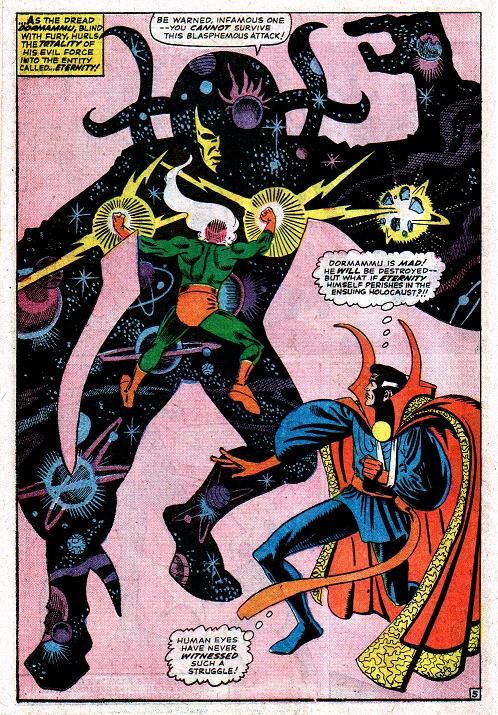
Dormammu takes on Eternity, courtesy of Steve Ditko

Take the first story. It starts with a man suffering from nightmares recalling hearing about how Doctor Strange could help with situations like this. He goes to visiti him, Strange infiltrates his dreams and it turns out Nightmare is behind the guy’s troubles, attempting to lure Strange. into his own realm. While Strange is held off by Nightmare, his pawn wakes up and realises why he was having terrible dreams: he’s been ripping people off in crooked business deals. He decides to kill Doctor Strange, but luckily the latter manages to use his magical amulet to stop him. It ends with Nightmare making threats to get Strange another time, while the good doctor convinces his patsy to turn himself in: “it will be the only way you can ever sleep again”.

Now this is the sort of strange mystery story you could also picture The Phantom Stranger starring in, somewhat of a throwback of what Marvel was doing just before they got into superheroes. It’s also clear that this is far from Doctor Strange’s first case: he’s well known enough that there are rumours about him and people know where to find him to get his help. No origin is given either, which makes him about the only classic Silver Age Marvel hero not to get their origin in their first story. It’s only in the fourth story that we do get the origin story, of how he once was a great surgeon until a car accident, drunk himself into vagrancy and went looking through the Far East to find a mystical solution for his problems but find himself training as a sorceror under the Ancient One instead… Again, not quite fitting in with the science orientated origins of most of Marvel’s other heroes.

What I liked about this volume was seeing Doc Strange being developed by Steve Ditko and Stan Lee, how seemingly throwaway references to e.g. Dormammu gets picked up later, culminating into the sixteen issue epic battle between Strange and Baron Mordo/Dormammu which ends Ditko’s run.

At this point we’re still only twothirds through the volume, with the last, Ditko free-third being much less interesting, much more pedestrian superheroics. If you read through this volume in one sit, it’s clear that whatever Lee’s contribution to things, it was Ditko who was the creative force behind Doc Strange. The art as well, though in the hands of capable artists like Bill Everett, Marie Severin and Dan Adkins is a huge letdown after Ditko.

What Ditko did with Doctor Strange was create the way in which every subsequent artist would depict magic, creating a whole visual language so to speak to depict other dimensions, magical spells, psychic duels and so on. And he does so while staying firmly within normal panel layouts, not resorting to trickery like breaking panel borders, or unusual layouts or even that many splash pages. It’s all there in the usual three-two-two or three-three-three layout. But when he does do a rare splash page, it’s a beauty, as you can see above…

In short: a great volume of which the last third is not very essential.

The Fug? No kissey cheeks for Dutch lawyers

So two years ago a lawyer greets a client and friend of his with the usual awkward three kisses on the cheeks. An assistant D.A. is offended, gods know why and complains to the tribunal. Wheels of justice grinding incredibly slow, this important case only reached the tribunals on the 25th of august. The verdict: cheek kissing is a no-no. The guy in question did not act according to the standards of the profession and he should’ve kept his distance even if he was friends with this client.

I’m not sure who has the biggest stick up their arses: the tribunal for reaching this verdict or the numptie who complained in the first place. What the hell is wrong with you you start a complaint because somebody kisses a friend on the cheeks?

What you get when not freaking out about teen sex

Comparison of number of gonerrhea cases in Holland and America

33 times fewer gonorrhea cases in the Netherlands amongst teenagers than in the United States for a start. But also drastically lower rates for HIV infection, Syphilis, teen pregnancy, abortion, undsoweiter. It’s almost as if treating teenagers having sex as a normal part of growing up and sexuality something you can teach your children about to treat with care and respect you can actually avoid or drastically lessen the dangers of sexualy ignorance… Honestly, even the danger of getting killed by a serial killer when losing your virginity is less in Holland. The Dutch approach isn’t perfect of course, there have been setbacks in recent years, but on the whole it scores so much better than trying to scare teenagers away from sex.

But even if the Dutch system was perfect, it still has one big flaw that would always keep it from being adopted in the US: it’s not punitive enough. Too many people do not want their — and others’ — children to be safe so much as punished. It’s the old idea that good people don’t have sex until they’re married and if they can’t wait, they deserve what they get. Let’s not even mention homosexuality or other “deviant” behaviour…

What’s strange is why America has gotten so fucked up about, well, fucking, when European countries like the Netherlands have long since outgrown such feelings. Holland used to be a strict calvinist, moralistic country as well after all, but we changed while the US slid back. Even our religious nutters are so much less strident than we’ve seen from across the Atlantic. It’s a mystery.

South Park conservatives? Try Merry Marvel conservatives

Venerable Comics blog ComicsComics has proof that the annoying tendency of modern conservatives to see evidence of conservative values in any halfway popular media phenomenom. But whereas today it’s television series like South Park, Lost or even The Wire they like to claim for the rightwing, back in 1966 it was Marvel comics:

But despite their lightheartedness, the heroes are indeed heroic, and the villains villainous. This in itself is not amazing—but the fact that the heroes run to being such capitalistic types as arms manufacturers (Tony Stark, whose alter ego is Iron Man), while the villains are often Communists (and plainly labeled as such, in less than complimentary terms) is a breath of fresh air in a world such as ours, where all too often “good guys” and “bad guys” are portrayed as being indistinguishable.

And it is in their frank recognition of the difference between good and evil that makes Marvel Comics, at least in my opinion, “right wing” in tone. The “Bullpen Gang,” as the Marvel staffers refer to themselves in print, is not afraid to say that good and evil are mutually incompatible. Furthermore, they equate good with freedom and evil with totalitarianism, whether Communist, Nazi, or inhuman in origin. This is the “message” so assiduously repeated in all their sagas—and with such a message, no YAF member should have any quarrel.