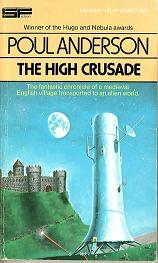
The High Crusade – Poul Anderson

Cover of The High Crusade


The High Crusade
Poul Anderson
167 pages
published in 1960

Poul Anderson has a not undeserved reputation as a deeply pessimistic, even depressing writer, largely based on his later novels which all seemed to share the assumption that human nature is unchangable, that evil will always be amongst us, progress impossible and the future will always end badly. It must have been something to do with his gloomy Danish genes. The High Crusade shows it was not always this way. Once upon a time even Poul Anderson could write a lighthearted science fantasy romp without some great clonking moral to mess it up.

Great fun it is too. It’s the year 1345 and a small town in Lincolnshire is visited by a spaceship belonging to the Wersgorix Empire, while the local baron Sir Roger de Tourneville was busy gathering men to join king Edward III in France. Thinking the landing a French trick, he and his men storm the space ship and overwhelm and kill almost all of the aliens, who have long since grown unused to hand to hand combat. Ordering the remaining alien to take them to France, Sir Roger loads the entire town into the ship, but the alien tricks them and sets course back to the planet it came from. Lots of adventures and misunderstandings follow and it ends with Sir Roger conquering the entire Wersgorix Empire…

Read more and see also the celebrations over at Tor.
QotD: sadly true of way too much science fiction

Over at James “sadly nto a Hugo Award winner yet” Nicoll’s place, while discussing a sf novel which will remain nameless, Fridgepunk remarks:

a lot of sci-fi makes a bit more sense if you assume it is all historical fiction written by people from a deep time future where the primary knowledge about what people were like back in the day is gleaned from the archives of FF.net and a stash of evopsych journals discovered amid the archeological remains of an objectivist’s “tomb”.

Ouch.

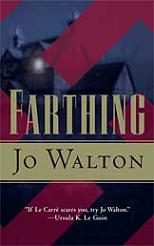
Farthing – Jo Walton

Cover of Farthing


Farthing
Jo Walton
319 pages
published in 2006

At first glance Farthing seems to be a classic English cozy country house mystery, if set in an alternate England. There’s the locked room murder taking place during a weekend party at the Farthing country estate. There are the clues pointing all too neatly at one of the guests. There’s the doughty detective refusing to believe them and there’s the slow deduction of the real killer’s identity and motivations. It all feels like something Agatha Christie or Josephine Tey could’ve written — the latter’s unconscious class snobbery being consciously used here — but in the end Farthing turns out to be something very different from the cozy mystery or even alternate history tale it masquerades as. This is in fact a horror story, with the horror provided not by the plot or the characters, but through the setting. As Ursula Le Guin puts it in her front cover blurb: “If Le Carré scares you, try Jo Walton”.

Farthing grabbed me by the throat from the first page and didn’t let go; one of the very few books to have ever done that. As with any other alternate WWII story, part of that is due to what you know is going on in the background that the characters themselves do not know yet or only suspect. Every such Hitler wins story depends on the tension between what the reader knows happened historically and what the characters in the story know or do not know: sometimes this is done explicit, as in Fatherland, where the whole point of the book is to get the protagonist up to speed on what we as readers already know. In Farthing‘s case though things are kept implicit. What Walton does is let the essential horror of the setting speak for itself, keeping the swastikas and Gestapo goons offstage. What she does in fact is showing that England did not need these props to become a fascist state.

read more

What Twitter was made for

Epic is not the word for it, Chris Brooke’s Tour de Force retweeting of Tony Blair’s autobiography. Thanks to his sacrifice there’s no need to read it yourself anymore — you can get the gist of it from the quotes:

42. Blair, p. 65: “On that night of 12 May 1994, I needed that love Cherie gave me, selfishly. I devoured it to give me strength.” Wed Sep 1 12:03:56 2010 via web

[…]

163.Blair doesn’t say that something is funny, he says (p. 290) that there had been “a proper quotient of amusement”. Wed Sep 1 19:15:17 2010 via web

[…]

215.Blair broods, p.373, every day, on the victims of his wars, & “uses that reflection to recommit to a sense of purpose in the bigger affair.” Thu Sep 2 09:27:54 2010 via web

216.Blair, p. 373, “can only hope to redeem something from the tragedy of death, in the actions of a life, my life, that continues still.” (Wow) Thu Sep 2 09:28:56 2010 via web

[..]

426.Blair, p. 509: “The British people, whom I genuinely adored… like a love affair, had ceased loving and were not going to start again.” Thu Sep 2 20:15:41 2010 via web

[…]

529.Blair, p.567: the killing of JC de Menezes was a “terrible error”, but he also feels sorry for the officers, “who were acting in good faith” about 21 hours ago via web

[…]

554.Blair, p. 578: the heart of New Labour was its “championing of aspiration”. “Equity cd not & shd never be at the expense of excellence.” about 21 hours ago via web

[…]

771.Blair, p. 670: “Keynes was a great man”, but “I bet he would be surprised at how his theory is being applied today.” about 14 hours ago via web