A blog written just for me

It’s like somebody looked into my brain and made a blog especially for me: Captain America’s Been Torn Apart, devoted to reading and commenting on Mark Gruenwald’s entire ten year run on Captain America. David Fiore is a veteran comics blogger and he gets both Gruenwald:

One thing I do want to stress, re: Gruenwald, is how much I appreciate his refusal to join the “Comics Aren’t Just For Kids” sweepstakes of the mid-1980s. We can all agree how dumb that was, can’t we? What I love about these books (and about Squadron Supreme in particular) is the way they wade into the same contested super-political waters that Miller and Moore were then “braving,” without swaddling these ambitions in the cloak of the medium’s much-trumpeted “coming of age.” Basically, Gruenwald is saying that the genre was always concerned with these questions–damn the “prestige format,” full speed ahead!

And Captain America:

So… created by Jack Kirby and Joe Simon in late 1940, Cap was (and is) the preeminent symbol of “premature anti-fascism” (to use HUAC terminology) in the history of American literature. He is, quite simply, THE Popular Front (that’s a New Deal era coalition of communists, socialists and others leftists) icon. There cannot be any dispute about that. Punching out Hitler meant something very different in December 1940 than it means when today’s Neocons cum in their PJs while dreaming about it…

There have of course been quite a few writers attempting liberal superheroics: Steve Gerber, Don McGregor Mike Friedrich, Steve Englehart are examples that spring to mind, but Gruenwald is in a class apart. Nobody was as consistent in their approach as Gruenwald, whose favoured protagonists like Cap, or Quasar were liberal, friendly and approachable heroes whose politics were portrayed through their day to day adventures, rather than by doing Very Special Issues about the Klan or womens’ lib or whatever. Cap especially pays more than just lip service to the idea his opponents can be reformed, rather than are intrinsincly evil, and this during the Reagan Era when every other superhero title seemingly moved to the right, becoming “gritty” and “realistic” by depicting criminals as subhuman scum for the hero to blast away. It’s therefore great to see somebody willing to spent substained critical effort on showcasing Gruenwald’s run on Cap.

How many spoons can you spend today?

As anybody who has been following Wis[s]e Words this year you know S. and I have been struggling with the recovery from “our” kidney transplant. Myself I’ve fortunately only had about a week of physical recovery time from the operation, plus another month or so of struggling with a opportunistic wound infection. S. on the other hand had been living with a lowered kidney function for years and while the transplant has made that more or less normal, the side effects have so far prevented her from enjoying a “normal” life.

One benign side effect of the transplant is that S.’s medicial problems have come out in the open, in so far that people understand why she so often was incapable of joining family functions and such. Any sufferer of a chronical illness or disability, especially the less visible ones, knows it can be difficult to explain why you can’t do normal, everyday things. Fantasy author Jay Lake (buy his books) knows the problem, due to his bout with cancer. To explain what it feels like, he talks about spoons:

Basically, the idea is when you’re sick that way (or in my case, in post-op recovery followed by chemo), you can still do anything you want. You just can’t do everything you want. People in full health start their day with a very large supply of spoons, the spoons representing increments of energy or attention or focus, and spend them as they go through their days. People in limited health have fewer spoons. Simple things like taking a shower can take a lot out of a person, for example. So you wind up asking yourself questions like, “do I have enough energy to take a shower and to do a load of laundry?” Because you have enough spoons to do either but not both.

The spoon theory was thought up by Christine Miserandino of butyoudontlooksick.com. Here she explains how she first used spoons to let a friend understand what it felt like to live with Lupus:

I asked her to list off the tasks of her day, including the most simple. As, she rattled off daily chores, or just fun things to do; I explained how each one would cost her a spoon. When she jumped right into getting ready for work as her first task of the morning, I cut her off and took away a spoon. I practically jumped down her throat. I said ” No! You don’t just get up. You have to crack open your eyes, and then realize you are late. You didn’t sleep well the night before. You have to crawl out of bed, and then you have to make your self something to eat before you can do anything else, because if you don’t, you can’t take your medicine, and if you don’t take your medicine you might as well give up all your spoons for today and tomorrow too.” I quickly took away a spoon and she realized she hasn’t even gotten dressed yet. Showering cost her spoon, just for washing her hair and shaving her legs. Reaching high and low that early in the morning could actually cost more than one spoon, but I figured I would give her a break; I didn’t want to scare her right away. Getting dressed was worth another spoon. I stopped her and broke down every task to show her how every little detail needs to be thought about. You cannot simply just throw clothes on when you are sick. I explained that I have to see what clothes I can physically put on, if my hands hurt that day buttons are out of the question. If I have bruises that day, I need to wear long sleeves, and if I have a fever I need a sweater to stay warm and so on. If my hair is falling out I need to spend more time to look presentable, and then you need to factor in another 5 minutes for feeling badly that it took you 2 hours to do all this.

The spoon theory is not meant to make people feel sorry for people like Christine, Jay or S., but to show a little bit of what they have to deal with. People are not defined by their illness or disability, but the spoons theory shows that they have to take into account their limitations.

(Just Another) Metal Monday

If y’all been following Metal Monday the past couple of weeks you may have noticed the preponderance of death metal. This is not just because it’s one of my favourite subgenres, but also because so many of the better death metal bands seem to cluster in the early part of the alphabet. Today we have the classic Florida death metal band, Death itself, now sadly defunct after founder Chuck Schuldiner “pulled the plug” in 2001, having died of brain cancer. Though he denied it himself, he and his band were incredibly influential in shaping the genre and you can do worse than to buy their first two albums, Scream Bloody Gore and Leprosy. The latter album is represented here with the title song:


Diamond Head was a New Wave of British Heavy Metal band who never quite made it into the big time, but gained fame because Metallica nicked all their best songs, including this one: Am I Evil:


Finally, another Death Metal band, Deicide, with “Lunatic of God’s Creation. Unlike Death, Deicide is a seriously anti-religious, anti-Christian band; their name of course means “god murder”. It’s all so much posturing however, despite the socalled satanic messages in their music, Deicide doesn’t actually believe any of it, unlike the more extreme Norwegian Black Metal bands. The latter’s loathing of bands like Deicide and touring partner Gorefest might actually have led to an attempt to blow the band up live on stage in Stockholm…


That last video also nicely shows off the “death metal grunt” voice.

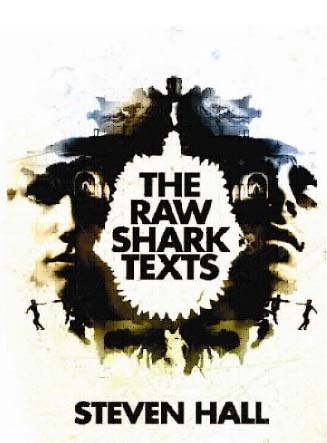
The Raw Shark Texts – Steven Hall

Cover of 
The Raw Shark Texts


The Raw Shark Texts
Steven Hall
427 pages
published in 2007

The Raw Shark Texts was marked as science fiction in my local library, which is why I glanced at it while browsing the fiction shelves. “Mindfuck” would be a better classification howeve, one of those books that break down the realities of your world and has you looking for monsters out of the corners of your eye. Reading it on a long, delayed train journey with nothing else to distract me while it was slowly getting dark helped a lot as well.

Steven Hall sucked me in from the first two sentences: “I was unconscious. I’d stopped breathing.” I should quote the first three and a half pages to show how Steven Hall builds up the scene from there, as his hero wakes up in an explosion of coughs and deep breaths, takes stock of his situation and then realises he doesn’t know where he is or who he is. He pats his pockets, locates a driver’s licence and tastes the name it gives him: Eric Sanderson. The scene ends with that discovery, with a new scene opening in a therapist’s sitting room, as she explains what’s been happening to him. While she explains, flashbacks explains how Eric got there: going downstairs from the bedroom he awoke in, he found a letter by the telephone, a letter from “the first Eric Sanderson”: who tells him to go to this therapist.

Read more…

Garbage collectors on strike with Queensday

garbage left behind after Queensday 2009

The picture above shows just a little of the garbage left over at the end of Queensday last year. Held on the 30th of April, the birthday of our previous queen, Queensday is one of our most important holidays, in which we can indulge in our traditional vices of drink and commerce. It’s a day when, as one wag described it, one half of the Dutch population is selling the contents of their attics to the other half and the city in which the most of this is done is Amsterdam, party central on Queensday. It all makes for quite a lot of mess.

And this year the garbage collectors are threatening to strike. Not just on the day, but the entire week from Queensday, which also includes a potential Ajax championship celebration as well as Rememembrance Day on May 4th and Liberation Day on May 5th. It’s perhaps the worst period in the year to have this strike, hence a good way for the unions to pressure the city.

For the garbage collectors are not just striking for themselves, but for all municipal civil servants. The demands are modest — basically wanting to keep salary levels matching inflation — but the Dutch city councils have refused so far to meet them. My sympathies therefore are with the garbage collectors and I’ll make sure to keep my own (modest) garbage safe until the end of the strike…