Wilders refused entry

So Wilders tried getting into the UK anyway and got turned away at Heathrow:

A Dutch MP who called the Koran a “fascist book” has been sent back to the Netherlands after attempting to defy a ban on entering the UK.

Freedom Party MP Geert Wilders had been invited to show his controversial film – which links the Islamic holy book to terrorism – in the UK’s
House of Lords.

But Mr Wilders, who faces trial in his own country for inciting hatred, has been denied entry by the Home Office.

He told the BBC it was a “very sad day” for UK democracy.

The Dutch ambassador was also at Heathrow to make clear his government’s opposition to the ban on Mr Wilders entering the UK.

Schadenfreude or not, the way in which the UK government handled l’affaire Wilders was really cackhanded. By banning him from the country they’ve overinflated his importance, gave him another chance to play martyr for free speech and got him a shitload of free media attention, more than he could’ve gotten showing his nasty little film in the House of Lords. Showing Fitna there might have been a provocation, but the way this was handled you still have the provocation but now with added legitimisation.

Undesirable alien

Geert Wilders

turnabout is fair play. Geert Wilders is denied entrance to the United Kingdom because he’s a threat to public safety:

A far-right Dutch MP whose film linking Islamic texts with the terror attacks on New York sparked protests around the Muslim world was last night banned from entering Britain.

Geert Wilders, who leads the small Dutch Freedom Party, was due to show his controversial 17-minute film at an event in the House of Lords tomorrow, but was informed yesterday by British officials that he would not be allowed to enter the country. The decision sparked an immediate diplomatic row after the Dutch Government pressed Britain to reverse the ban.

Now he knows how it feels to be an undesirable alien. He and his allies are of course squealing like stuck pigs about this outrage but really it’s no different from wanting to limit the number of Antillians coming to the Netherlands even though they’re Dutch citizens, to name just one example. That this has led to a diplomatic row between us and the Brits was predictable, even though we should be ashamed Wilders got elected to our parliament in the first place. Refusing him entry to the UK isn’t an insult to parliament: having him in the Tweede Kamer is an insult to parliament.

Award lists considered harmful

Via James Nicoll, the list of winners of the John W. Campbell Memorial Award for Best Science Fiction Novel (but not the John W. Campbell Award for Best New Writer). In bold are those I’ve read, while the ones I read but thought filled a much needed gap in literature are struck through:

  • 1973 – Beyond Apollo, Barry N. Malzberg
  • 1974 (tie) – Rendezvous with Rama, Arthur C. Clarke; Malevil, Robert Merle
  • 1975 – Flow My Tears, The Policeman Said, Philip K. Dick
  • 1976 – The Year of the Quiet Sun, Wilson Tucker (special retroactive award for a novel from 1970)
  • 1977 – The Alteration, Kingsley Amis
  • 1978 – Gateway, Frederik Pohl
  • 1979 – Gloriana, Michael Moorcock
  • 1980 – On Wings of Song, Thomas M. Disch
  • 1981 – Timescape, Gregory Benford
  • 1982 – Riddley Walker, Russell Hoban
  • 1983 – Helliconia Spring, Brian W. Aldiss
  • 1984 – The Citadel of the Autarch, Gene Wolfe
  • 1985 – The Years of the City, Frederik Pohl
  • 1986 – The Postman, David Brin
  • 1987 – A Door into Ocean, Joan Slonczewski
  • 1988 – Lincoln’s Dreams, Connie Willis
  • 1989 – Islands in the Net, Bruce Sterling
  • 1990 – The Child Garden, Geoff Ryman
  • 1991 – Pacific Edge, Kim Stanley Robinson
  • 1992 – Buddy Holly Is Alive and Well on Ganymede, Bradley Denton
  • 1993 – Brother to Dragons, Charles Sheffield
  • 1994 – No award
  • 1995 – Permutation City, Greg Egan
  • 1996 – The Time Ships, Stephen Baxter
  • 1997 – Fairyland, Paul J. McAuley
  • 1998 – Forever Peace, Joe Haldeman
  • 1999 – Brute Orbits, George Zebrowski
  • 2000 – A Deepness in the Sky, Vernor Vinge
  • 2001 – Genesis, Poul Anderson
  • 2002 (tie) – Terraforming Earth, Jack Williamson; The Chronoliths, Robert Charles Wilson
  • 2003 – Probability Space, Nancy Kress
  • 2004 – Omega, Jack McDevitt
  • 2005 – Market Forces, Richard Morgan
  • 2006 – Mindscan, Robert J. Sawyer
  • 2007 – Titan, Ben Bova
  • 2008 – In War Times, Kathleen Ann Goonan

Not a great score, though several of the books I haven’t read yet are on my bookshelves (e.g. Gloriana). Others though, especially post-1990, just don’t appeal at all. McDevitt, Sawyer and Baxter for example are all writers who are at best mediocre (though Baxter surprised me recently). Which brings me to the question of whether anybody ever uses these award lists as a reading guide? If you’re already familiar with science fiction and fantasy seeing who’s nominated for a Hugo might be interesting, but what if you’re new to the genre? Personally I doubt these lists will give you a good overview of the field.

Take the two biggest awards. The Hugo is voted on by a dwindling number of science fiction fans who take the trouble of registering for this year’s Worldcon and whose taste tends towards the conservative and middle of the road. The Nebula on the other hand is determined by the Science Fiction Writers of America members, which sounds better than it is, as there’s a lot of politics involved in determining the winners and again the members tend to be more conservative than the actual readers. With both there have been long stretches in which the award was consistently given to mediocre books. So if you’re a new reader or trying to assemble a reading list for somebody to get acquainted with science fiction, just following the award lists would lead to reading a lot of godawful dull books.

When I started reading science fiction I did it through the local library, then later discovered fanzines (Holland SF) which pointed me in the direction of good books; these days there are of course plenty of blogs talking about sf as well. That would be my advice: try books out from the library and look for reviewers you trust, rather than award lists.


Happy birthday, frikandel!

A plate of frikandel with fries

According to a press release put out by a well known Dutch fast food maufacturer, today is the fiftieth anniversary of the invention of the frikandel. The story is that on this day in 1959 Jan Bekkers invented this popular sausage like snack when he started up his fast food factory; he was also supposed to have changed his name at the same time to Beckers in order to be first in the phone book before his competition, his cousin. A nice story and I’ve chosen to believe it for the sake of this post, but it’s quite clear it’s only a story and the frikandel has a much longer history dating back to the eighteenth century at least.

If you’re never been to the Netherlands you’ll likely have never encountered this particular meaty treat. The picture above shows one to perfection: a long, skinless dark brown sausage made of mixed meats, deep fried and usually eaten with fries, often covered in a sauce mixture of mayonaisse, curry or tomato ketchup and diced raw onion. There’s no truth to the rumour it’s made of all the disgusting left over bits of animals (lips, buttholes and eyeballs being particular popular grossout ingredients), at least not since the Dutch food standards agency made this illegal. These days there are even proper halal frikandellen.

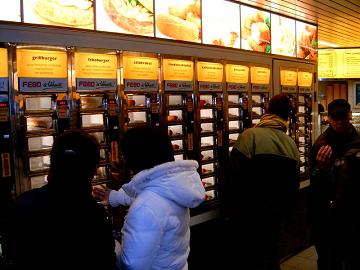
a FEBO snack bar

Honestly it tastes better than it looks and you don’t need to be drunk to enjoy; millions of Dutch kiddies grew up with a regular saturday evening meal of fries and frikandellen. Unlike its stable mate, the kroket, it has not yet been improved in order to chase the luxury market; it’s as decent and honest a fast food treat you can get. If you ever visit the Netherlands, do try one but take care not to take one from the vending machines at the FEBO, as you never know how long these have been stewing behind the glass…

Holland can has Iraq inquiry — but not yet

Yesterday was the big parliamentary debate about whether or not there would be an inquiry into the Iraq War. Over the weekend Balkenende had proposed to let an independent commission take a look at Dutch participation in the war, while the opposition wanted a proper parliamentary inquiry. But because the governmental parties had a majority in government and even though many of the social democrats did want a proper inquiry, the result was one of those typically Dutch compromises. Balkenende dropped his resistance, but only if parliament would agree to his ideas about an independent commission first. The upshot is that a proper inquiry has been kidked into the long grass, as the commission will have six months to research all questions about Dutch involvement in Iraq. What’s more, during this time the government will also refuse to answer any new questions about Iraq, in order to “give the commission room to work”.

In all, Balkenende has done well. He”s bend to the will of parliament and defused what could’ve become a government crisis without actually having to compromise. The danger is that with this long delay the inquiry will disappear of parliament’s radar and hence never happen, which he won’t mind much…