Science fiction is no good they holler until we’re deaf…

If it’s good, then it’s no sf:

What do novels about a journey across post-apocalyptic America, a clone waitress rebelling against a future society, a world-girdling pipe of special gas keeping mutant creatures at bay, a plan to rid a colonisable new world of dinosaurs, and genetic engineering in a collapsed civilisation have in common?

They are all most definitely not science fiction.

Literary readers will probably recognise The Road by Cormac McCarthy, one of the sections of Cloud Atlas by David Mitchell, The Gone-Away World by Nick Harkaway, Stone Gods by Jeanette Winterson and Oryx and Crake by Margaret Atwood from their descriptions above. All of these novels use the tropes of what most people recognise as science fiction, but their authors or publishers have taken great pains to ensure that they are not categorised as such.

On the one hand, it’s enough to give any genre an inferiority complex. Science fiction has always been uncool and unloved, rarely getting widespread critical love or street cred, but with many of its best practitioners getting siphoned off into the realms of literature being discovered years or decades after science fiction fans had discovered their talents. It’s not just mainstream writers or their publishers quick to distinguish their novels of the future from the dreaded esseff, it’s also the retroactive reclassification of writers like Ballard, Dick or LeGuin as something better than mere sf writers. It’s cultural appropriation of the worst kind (joke…)

On the other hand, I do understand why certain writers want to distance their books from the genre. Leaving aside base commercial motivations, it’s also a way of managing expectations. A novel like Margaret Atwood’s The Handmaid’s Tale for example wasn’t written as a science fiction
novel, but in the spirit of a much older literary tradition, the utopian/dystopian story. It doesn’t conform to science fiction conventions and its science fictional content is there as a tool, not a purpose.

On the gripping hand, this sort of thing can be really irritating, especially when you get mainstream writers who are trying to write proper science fiction, without love for the genre or much knowledge about and whose pedestrian treatments of lonmg chewed over ideas are hailed as groundbreaking.
P. D. James’ The Children of Men is a good example of this: an old idea, not very well thought through but published to wide critical acclaim denied to the sf works that treated this same subject better (like Philip Jose Farmer’s short story “Seventy Years of Decpop”).

But what can you do? Compared to where we were even twenty years ago we can’t really complain and besides, for every literature snob there’s a science fiction fan proud of his ignorance of anything this side of Perry Rhodan. Read what you like and remember that mainstream literature is a genre too.
Books read January

I wasn’t sure I was going to continue with the monthly book reports, but I couldn’t resist it. Sixteen books read this month, of which no less than thirteen were detective novels and of those ten were by the same author, Ngaio Marsh. It helped that I was poorly for a week and unable to concentrate on anything more strenuous than formula fiction. Cozy detective novels are the perfect thing to read in that condition: I can read it almost on autopilot and a good detective writer is engrossing enough to still be entertaining.

The Quick Red Fox, Darker Than Amber and The Scarlet Ruse — John D. MacDonald
Three Travis McGee novels read in quick succession at the start of the year. Each has the same plot: a friend of Travis gets into trouble, gets murdered or in another jam and Travis solves the problem. The appeal of these books however is not in the plot but in the execution and the style with which MacDonald writes. These really are the apogee of intelligent formula writing.

Black as He’s Painted, Photo-Finish, Opening Night, Death at the Dolphin, False Scent, Death and the Dancing Footman, Death in a White Tie, The Nursing Home Murder, Artists in Crime, and Overture to Death — Ngaio Marsh
Ngaio Marsh is another writer of intelligent series fiction, one of the four “Queens of Crime fiction” (can you tell me the other three). I never really got her until my girlfriend got me to read Black as He’s Painted and then devoured the rest of these books, picked from her shelves as they appealed to me. Marsh had a long career, her last novel, Photo-Finish, was published in 1980 and it’s interesting to see the cozy detective formula being applied out of its home era (1920s to 1950s at the latest), the way in which Marsh was both contemporary and old fashioned, not quite keeping up with changing mores and styles. In contrast, the pre-war novels are much more in synch with the times, the contemporary cultural and political scene.

The Strange Death of Tory England — Geoffrey Wheatcroft
A chatty, informal history of the Tory party and its strange downfall just after its period of greatest succes, as if its reason for existence had disappeared with it. The author is definately a rightwinger, which caused me some slight irritation and sometimes a bit too chatty for my liking, but on the whole this was quite interesting.

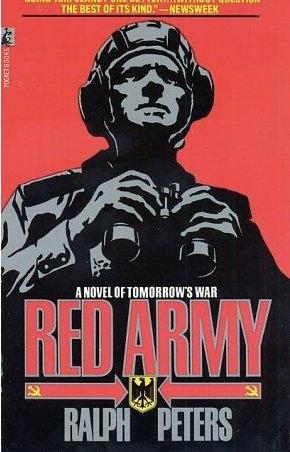
Red Army — Ralph Peters
A WWIII novel written in 1989, just as the USSR started to collapse. Par for the course for infinity star general Ralph “blood n guts” Peters, who these days is trying to sell the existential threat of Islamofascism to the US. It is surprisingly readable though.

Dansen Met De Duivel — Peter Rensen
Peter Rensen spent several months infiltrating the Centrumdemocraten, a party best compared to the BNP, just before the city council elections of 1994. This election turned out to be the high water mark for the party, which afterwards slowly dwindled until it was disbanded in 2002. Rensen sketches a portrait of a deeply racist party many of whose activists are not just racist, but open nazi sympathisers. At the same time, he also shows the party is deeply disorganised and not prone to do much activism other than putting out party political broadcasts.

Red Army — Ralph Peters

Cover of Red Army


Red Army
Ralph Peters
402 pages
published in 1989

Infinity star general Ralph “Blood ‘N Guts” Peters (as seen on Alicublog) is one of the more loonier cheerleaders for the War on Musl^wTerror. He’s a firm believer in both what Matt Yglesias dubbed the Green Lantern Theory of Geopolitics where America just needs the Will to vanquish its enemies and nothing else and in the unlimited threat of the Islamofascist menace, which so far, apart from a few exceptions, has been pretty weak. It’s not an uncommon strain in American conservatism, this doublethink about America being both the strongest and bestest country on Earth and its unique vulnerability to the enemy du jour, which is so much more cleverer, stronger and dedicated than the American people. It’s no surprise then that Peters has written a future war novel about a succesful Soviet invasion of West Germany, in 1989, just as the Berlin Wall fell, the Warsaw Pact countries overthrew their communist leaders and the USSR looked on without firing a shot in their defence. Of course, he’s not the only one to have been surprised by the fall of the Soviet Union; plenty of science fiction writers were embarassed too. Still, it’s typical of the man that he would write a novel warning of the dread Soviet threat at the exact moment it was all revealed to be hollow.

The main reason I bought Red Army then when I saw it at a secondhand bookstore was to have a laugh, to see what Peters would make of it. I expected it would be dreadful, with awful prose and awful writer, but in fact it turned out to be quite readable. His writing is easily on a par with the king of technothrillers, Tom Clancy, which is damning with faint praise, I know. But then you don’t expect good writing with these sorts of novels. Peters writes clearly, is good at describing the nature of war without bogging down into needless details, keeps the story moving quickly and uses immediately recognisable if stock characters: the young conscript with no clue what’s happening, the grizzled Afghanistan veteran airborne captain, the dedicated, toughminded but fair general and so on, and so on. Interestingly enough, unlike other World War III novels, Red Army is written solely from the Russian point of view and they get to win too. One further point in Peters’ favour is that he doesn’t share Clancy’s tendency to geek weapon systems and describe endless details of the weapons used. Peters talks about tanks, “the big guns of the battallion”, the “company’s fighting vehicles” rather than T-72s or BMP-1s.

Read more…

Dutch government did want to help invade Iraq

After last weeks revelations about the covered up legal advice not to participate in the occupation of Iraq, comes new evidence that the then government also wanted to participate in the actual war. Dutch broadcaster RTL, has gotten hold of several primary documents which made clear that the ministry of defence had already started preparations for Dutch participation while the government was busy laying the groundwork for a vote in parliament. This while Balkenende, then leading his first government, has always insisted military support for the invasion had never been considered.

All of which only strengthens the cause for a parliamentary inquiry, as so much still remains unclear about what the government knew and did not know about the War on Iraq. This, the question whether or not the Dutch participation in the occupation was legal, whether or not the government realised the weapons of mass destruction didn’t exist…

In a roundabout way it also shows that the protests against the war were not completely futile. The documents also revealed that while the government was considering military participation, the protest and widespread opposition amongst the Dutch against the war ultimately dissuaded them from it. Granted, it wasn’t a complete succes for the anti-war movement, as we still helped with the occupation, but it does show that protest can work.

The strictly impartial BBC, operating on behalf of the Israeli government

To update an old Young Ones joke. As seen on Prog Gold, the current BBC’s director general is quite cozy with the Israeli government, which of course did not influence the decision to remain impartial by not broadcasting an appeal for the IDF’s victims. Now Ellis Sharp reminds us that he has been impartial towards Israel from the start of his tenure when in 2004 the then Middle East correspondent was transferred to Africa:

Orla Guerin’s offence was to run stories not just about the grief of Israeli families who had lost family members to suicide bombers but also stories about the grief and suffering of ordinary Palestinian families. As one blogger put it at the time:

Guerin’s real sin, of course, is to show some sympathy for the victims of the Israeli bombing (that’s enough to brand her a “terrorist”).

Within days of Thompson meeting Sharon, Guerin was sacked as BBC TV Middle East correspondent and transferred to Africa.

As you’ll remember, Thompson became director general because his predecessor had to resign after the BBC got caught on a technicality and was keelhauled for it in the aftermath of the Hutton Inquiry. Thompson was brought in as very much a pair of safe hands who wouldn’t rock the boat, follow the establishment line ever more so than his predecessors and not embarass the government. Despite this, there have been several scandals during his tenure, from running unwinnable contests to sexing up a documentary about the royal family to of course the Ross/Brands clusterfuck. This seemed to have made the BBC gunshy, prone to overreact and moreover, seemed to have lost the corporation its political nous.

So while the BBC has always been careful to not upset Israel or its zionist cheerleaders in the UK, always had an internal bias towards Israel, it used to be much more subtle about this. Even five years ago, I don’t think it would’ve been so blatant as to refuse air time to a genuinely humanitarian appeal for the inhabitants of Gaza. But because the corporation has been so battered by the same politicians and tabloids that are such great friends of Israel as well, because it has been caught with its pants down so often lately, it has overreacted. And now even those people who are normally the first to accuse it of a pro-Palestinian bias are disgusted.

Poor Auntie Beeb. It just cannot win.