Hermann (1938 – 2026) — Nick — #ComicaDay (73)

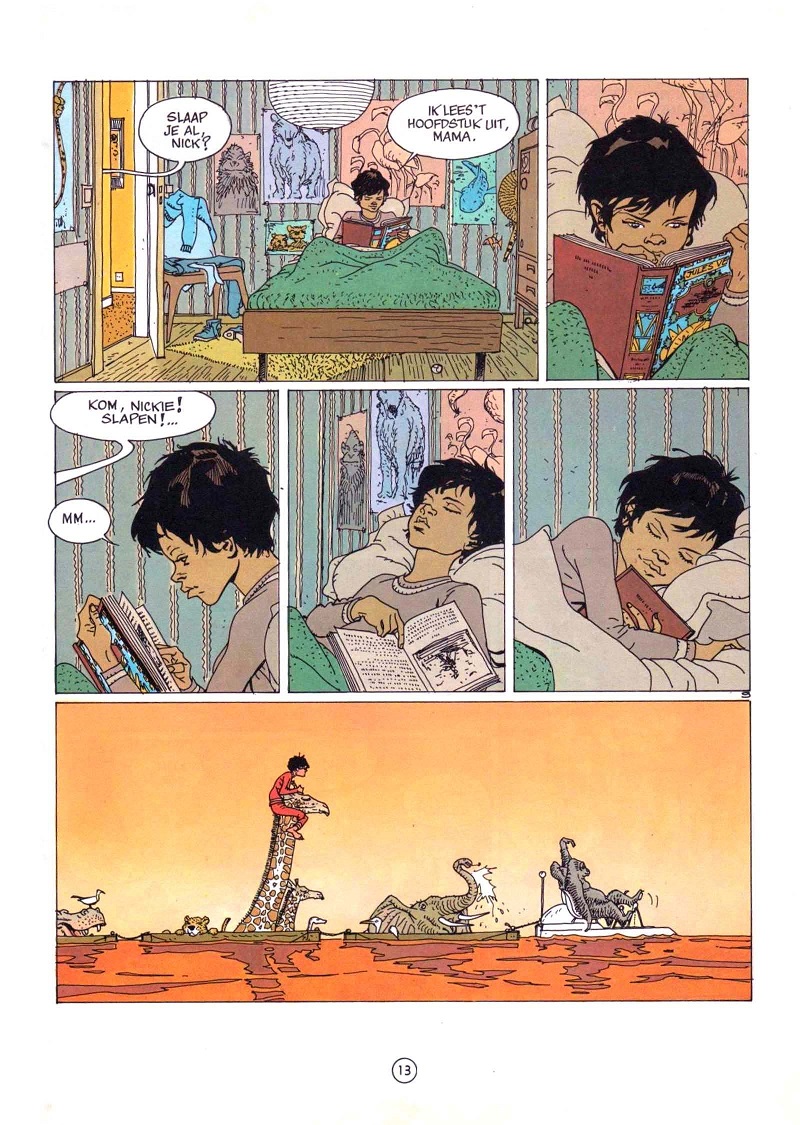
And now for something completely different, Hermann’s version of Little Nemo in Slumberland:

Nick is lying in bed, reading a Jules Verne book. His mother tells him to go to sleep and he does so, book still open. The page's last panel shows him in his red pyjamas on top of a giraffe with several other animals swimming in a red seas

An extremely charming little series about Nick, a little boy who in his dreams goes on all sorts of adventures with the animals he saved from an evil zoo owner. An odd duck in Hermann’s oeuvre, not just for the type of story it is but also for the art making much greater use of colour as a medium. The way he uses simple, single colour backdrops for the dream sequences while the real world portions are far more cluttered and less bright isn’t something you consciously notice, but it does distinguish the two perfectly.

This was also the very first series of Hermann’s I ever read, in the early eighties when these were first published, either from my local library which was well stocked with comics or because some of it was published in an educational magazine I read at school. This was long before I really was aware comics were actually made by real people, to be honest. Once I did know who Hermann was and what his usual series were like, rediscovering Nick was a bit of a shock.

The stories were written by Morphée, a pseudonym for Philippe Vandooren, Hermann’s brother in law, the same one who got him drawing comics in the first place. As Hermann tells it, originally another artist was supposed to draw the series, but he declined. Hermann himself was the second choice: neither his brother in law nor Hermann himself at first thought it would suit him…

Hermann (1938 – 2026) — Jeremiah — #ComicaDay (72)

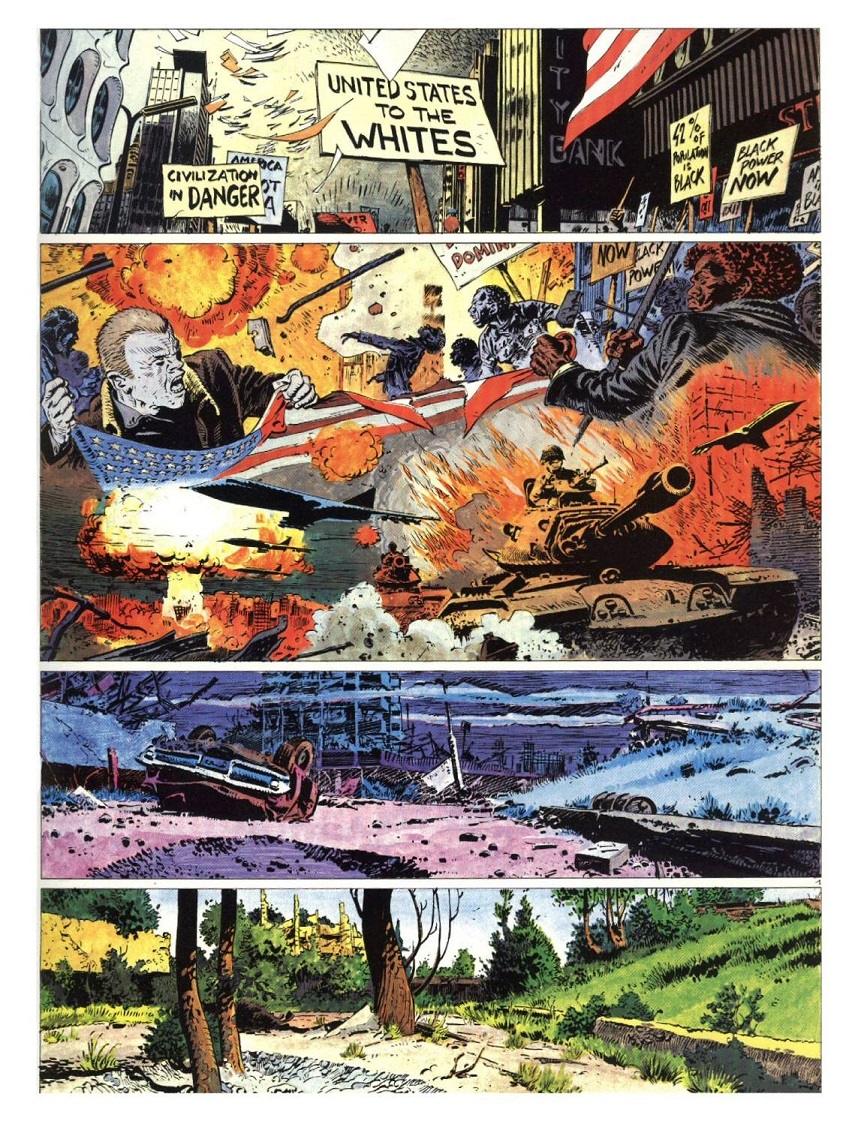
There have been few artists as effective at introducing the setting for their new series as Hermann is here, the first page of the first Jeremiah story:

The first page of Jeremiah 01, four full length panels. The first shows racial demonstrations, the second images of civil war, the third the ruins of a nuked city and the final panel shows how nature has grown up over them.

The idea of the United States descending into a racial civil war was “in the air” in the sixties and seventies, for obvious reasons. Hermann at this point had spent some time in America, having lived in Canada when younger and traveled extensively through the US as well. As he explained in an interview in Stripschrift 177, he felt that white Americans were high on their own presumed superiority while Black Americans were only waiting for the right opportunity to “kill whitey”. Which is why he choose this particular scenario to create the setting for his new western series.

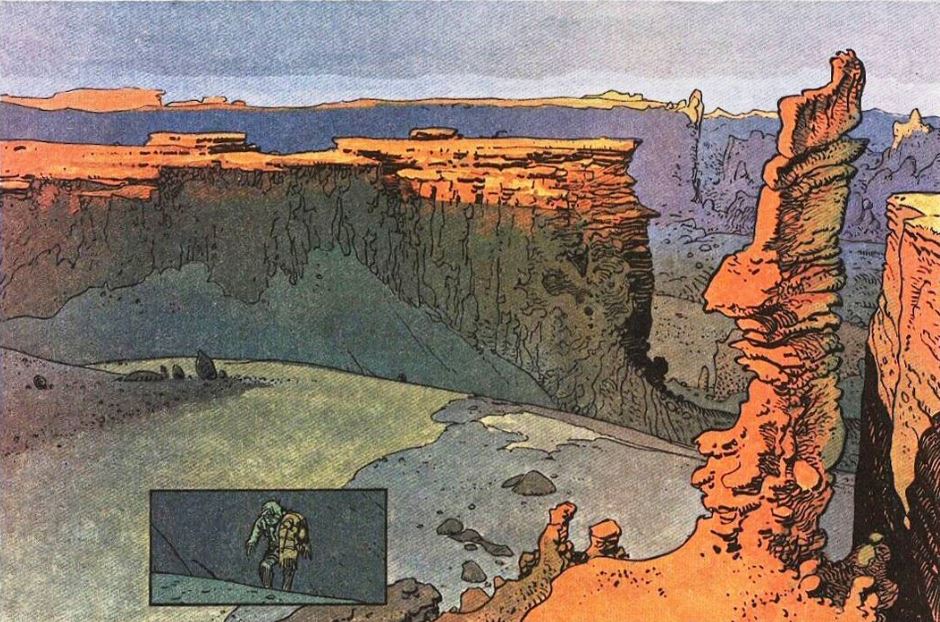
A desert landscape from Jeremiah 02

Because that’s obviously what Jeremiah was, a western, just one set in post-apocalyptic America rather than the 1870s. The first couple of albums especially would’ve needed little to remake them into straight western stories. Just look at that desert landscape above, seen in dozens of spaghetti westerns. Hermann was playing to his strengths, having spent a decade drawing Comanche when he started Jeremiah in 1978. The protagonists too are familiar types: Jeremiah himself, decent, naive, slightly dull and Kurt Vardy, a proper cynical villain but one with a heart of gold. The very first story sees Jeremiah’s home community destroyed and its people enslaved, with Kurt accidentally saving him from their fate. They end up fighting the man responsible for it, the corrupt boss of Langdon, the sort of lawless town again familiar if you’ve e.g seen A Fistful of Dollars. Jeremiah and Vardy riding away into the sunset at the end of it, the start of a beautiful friendship.

It’s a decent story but not that original or interesting to be honest. Far more interesting is the origin story of the series itself. Hermann until then had been a penciler, working for Greg on Bernard Prince and Comanche with little input on the plotting of these series. Though he enjoyed working with Greg, he also got frustrated by the limitations of this collaboration. Meanwhile there was a German publisher, Springer, who published a biweekly comics magazine Zack, with ambitious plans for going European. Zack already published new series by well known stars liker Charlier/Giraud, Jean Graton and Albert Weinberg, having poached them from the Franco-Belgian magazines and now offered Hermann the same chance. In 1979 Springer launched the French Super As and the Dutch Wham! and Jeremiah was one of the launch titles in it. This ambitious project failed miserably but Jeremiah was born.

Jeremiah is Hermann’s longest running and most successful series, with a fortyone albums published between 1979 and 2023. As the series evolved it lost some of its western characteristics, some stories even being entirely set in cities! Jeremiah got a television series in 2002, but that seems to have had little to do with the actual comic.

Hermann (1938 – 2026) — Bernard Prince — #ComicaDay (71)

Bernard Prince was the series that Hermann broke through with. Created in 1966 together with Greg, the hard working editor in chief and chief writer of Tintin magazine, one of the classics of the Belgian “Silver Age”.

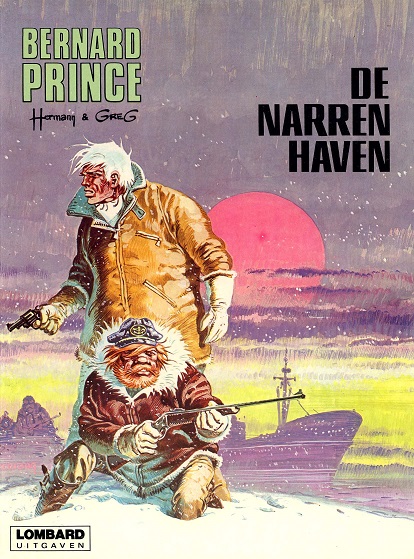
Bernard Prince, a white haired rugged looking man, holding a pistol with Barney Jordan crouching in front of him, against a snowwy backdrop

Hermann only became a cartoonist by accident: his brother in law Philippe Vandooren, later an editor at Dupuis and Spirou needed a comic for a scouting magazine and volunteered him for it. This and a few other bits and pieces got him noticed by Greg, who suggested he came and work for him. He did his yeoman’s work drawing episodes of Histoires de l’oncle Paul, true history story as told by a pedantic uncle to his niece and nephew, before he and Greg went to work on Bernard Prince.

Bernard Prince follows the standard Tintin adventure series template. You got a square jawed, slightly boring hero in Prince himself, with two more comedic sidekicks. The red haired, Scottish, slightly seedy and fond of a drink Barney Jordan and a young Indian boy called Djinn. At first Prince is a police officer working for Interpol, but before long he becomes a freelance adventurer, sailing the seven seas in his yacht the Cormoran.

Hermann and Greg would create thirteen long stories together, from 1966 to 1978, roughly one a year, as well as a few incidental short stories. As I noted back in 2012, only one has ever been translated in English, in 1973 for Wonderworld as translated by Fred Patten, better known for his work in anime and manga fandom. Thanks to Hairy Green Eyeball scanning and uploading this story back in 2008 it’s still available 18 years later.

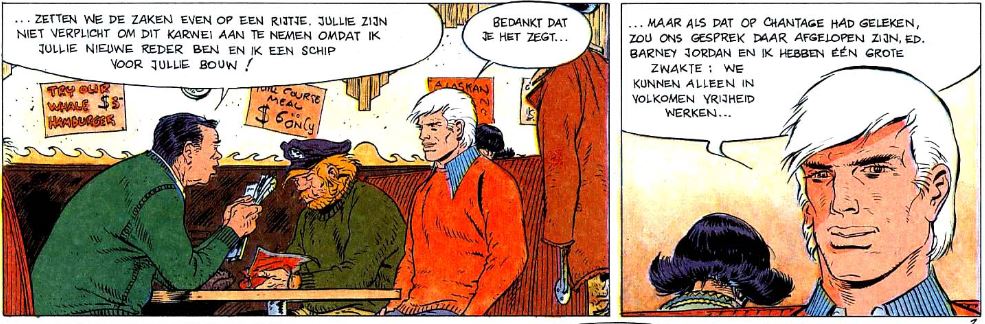
Two panels from Bernard Prince, with Prince looking slightly awkward in the first, in two-thirds profile

The cover above and the art throughout this post is from Hermann’s last entry in the series. When he started it his art style was still somewhat derivative of people like Eddy Paape, lacking some of the grit and realism he would develop later. Even in this particular album, though his art has improved dramatically from the first Bernard Prince story, still has a little bit of that flatness. You can see it in the first panel above, where Prince looks awkward next to the other two figures in the panel. His face in the second panel too is a bit stiff compared to what Hermann would draw a few years later. It’s as if he’s trapped by the need to adhere to Tintin‘s house style, such as it was and have Prince be a conventional, handsome hero.

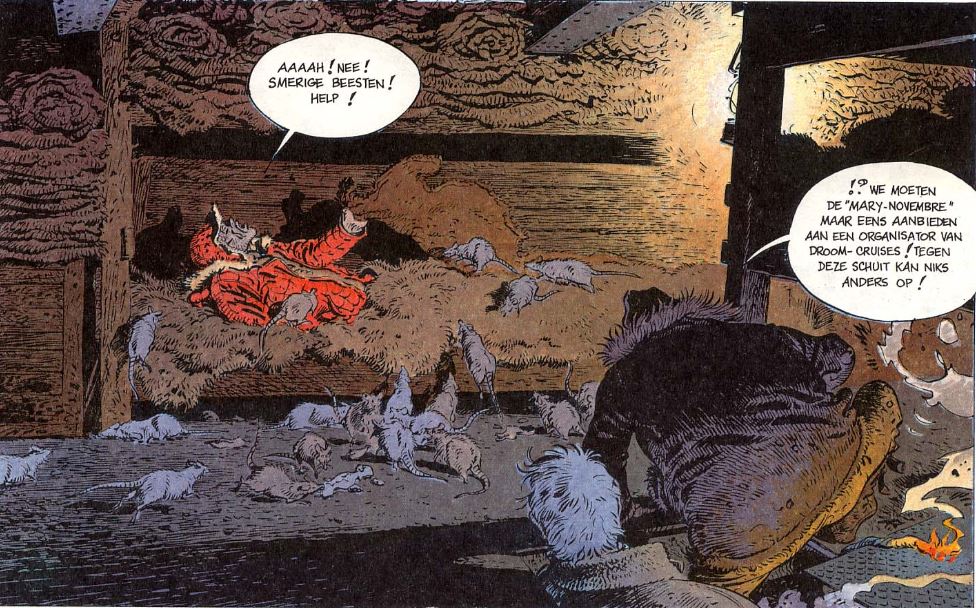
A wounded man is attacked by rats as a form of torture, as Barney and Prince try and rescue him

On Bernard Prince, as on Comanche, the western series he again started with Greg in 1969, Hermann was just the artist, with little to no input in the stories, though for Bernard Prince he did insist that each story feature some sort of natural disaster or extreme weather. (In this particular story for example Prince and Jordan have to investigate a lost freighter, trapped in ice in the Canadian Arctic). As Hermann grew more confident as an artist he also started to chafe under the restrictions he worked under. Hermann never was one for boy scouts or conventional heroes and he disliked the moralising tone Greg put in his stories. The world wasn’t fair, there’s no such thing as a true hero like Prince and he felt that comics should reflect this. Which is why, when he got the idea for a series all of his own, he dropped Bernard Prince, having outgrown the character, even though he would return for one last adventure with him, this time with his son Yves H. providing the scenario.

With Bernard Prince Hermann learned to become a comics artist. It and Comanche made his reputation of one of the most exciting of the new generation of realistic adventure cartoonists that broke through in the sixties. Though hard to imagine now, he, as well as similar artists like William Vance, were actually controversial for their embrace of cinematic violence and a willingness to acknowledge that the world wasn’t quite as black and white as portrayed in the fifties.

Hermann (1938 – 2026) — Sarajevo Tango — #ComicaDay (70)

Hermann Huppen passed away yesterday, aged 87, one of the giants of Belgian and European comics. Sarajevo Tango is not his best, but it is his angriest book.
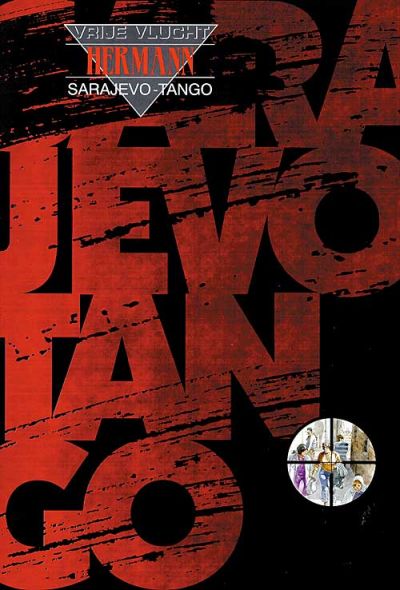
Sarajevo Tango

Sarajevo Tango is the sort of realistic adventure story that Hermann made his career from. Svonko Duprez, a half-Yugoslav, half French cynical mercenary is hired to rescue the daughter of a wealthy woman from Sarajevo. It’s sometime in the early nineties, the civil wars in Yugoslavia have begun and the city is under siege by Bosnian Serbs. Hard enough to find one little girl when sniper fire and mortar bombardment could kill you at any time, but Svonko will also have to deal with the girl’s father who wants to keep her in the city. Worse, there’s a murderer hired by her mother’s new husband keen to prevent the daughter from coming home as well.

Svonko is a typical Hermann protagonist: middle aged, world weary, who has only taken this assignment because he’s paid for it, yet is still honest enough to keep his promises. Despite all the dangers, the girl is safely reunited with her mother but Svonko himself doesn’t return from Sarajevo.
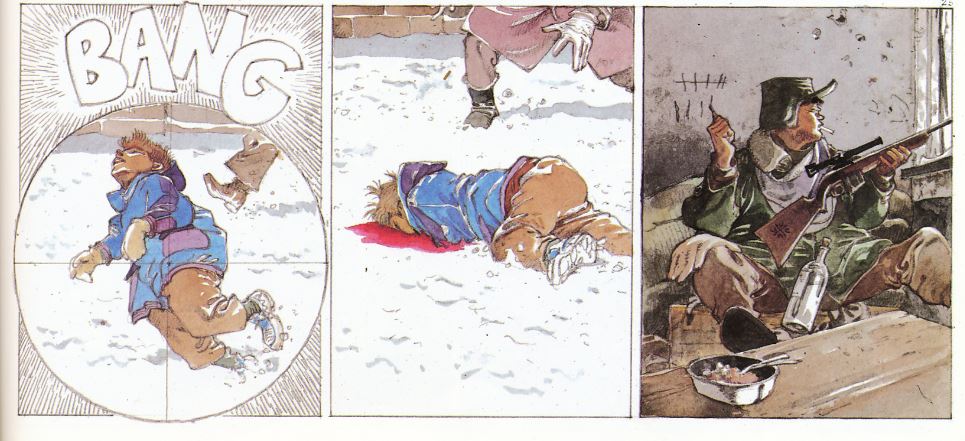
Through a sniper's scope a child is shot down. The next panel shows him bleeding in the snow. The third, a sniper adding another notch to his tally.

At first glance this may seen like just another torn from the headlines setting to give a bit of weight to a fairly standard adventure story, as Hermann had done before and after Sarajevo Tango. What sets it apart is his anger. Throughout the story we get vignettes like this, a glimpse at the daily horrors the inhabitants of Sarajevo had to deal with during the siege. These aren’t commented on by the characters, they just happen as the story unfolds. Hermann was only six years old as World War II ended, but he grew up in the shadow of it, the “never again” as the horrors of the war and especially the Holocaust became known. Yet here we were, four decades on and once again a genocidal war was fought in Europe and once again the so-called civilised world seemed powerless to stop it.
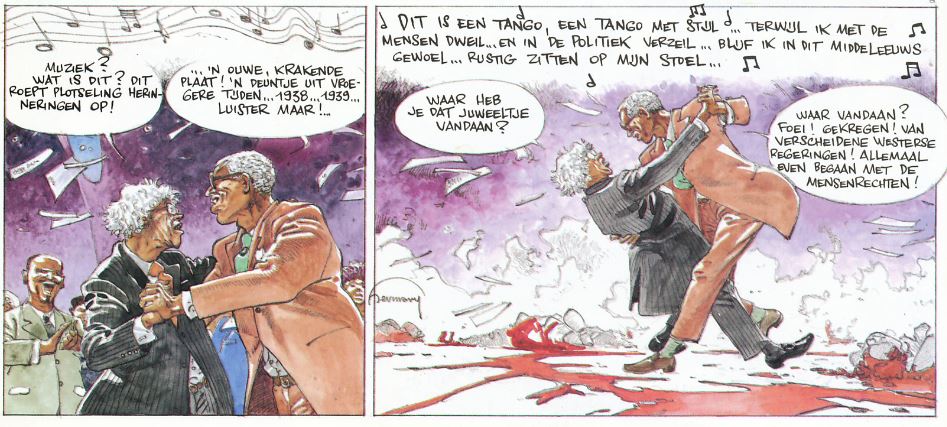
Lord Owens and Boutros Boutros-Ghali dance the tango on the bloodstained floor of the UN building

Hermann’s anger is also shown in his depictions of the UN peacekeepers, as blue helmeted smurfs, with negotiator Lord Owens and UN secretary-general Boutros Boutros-Ghali dancing the tango, “a tune from the good old days, 1938” in corpse strewn ballroom. A few pages further a giant wagging finger, courtesy of Boutros-Ghali floats over the city: “maybe this time it’ll last”, but it is deflating by the next panel. It’s not just the horror and revulsion of seeing the world powerless to stop this re-enactment of Europe’s darkest days that drives this satire, it’s also a personal anger that powered Hermann here.

Because caught up in this horror was his agent and close personal friend, Ervin Rustemagic, who ran Strip Art Feature, a comics publisher and agency, which had its offices in Sarejevo. Rustemagic mother was murdered by Bosnian Serbs together with the rest of her old peoples’ home in the early days of the war, while artillery bombardments destroyed the Strip Art Feature offices, destroying some 14,000 pages of original art in the process. It was Hermann’s failed attempts to get him and his family to safety that helped inspire Sarajevo Tango. Joe Kubert, who was also part of Rustemagic’s agency too would write about his ordeal that same year, in Fax from Sarajevo, which tells the story of life during the siege and how Rustemagic and his family managed to escape to Slovenia.

As a story, Sarajevo Tango is a bit mismatched, the fairly standard adventure plot is too slick, not matching the anger of everything else in it. As with Kubert’s similar attempt to come to grips with it, you get the feeling Hermann’s instincts as a commercial artist get in the way of the anger he wants to convey to you. Nevertheless, Sarejevo Tango stands as a testament to his character, to his ability to transform that helpless anger into something positive, no matter how flawed. Three decades on, it at least gives a good accounting of Hermann the artist as well as Hermann the person behind the artist.
An Uncomfortable Dose of Reality — Ikoku Nikki

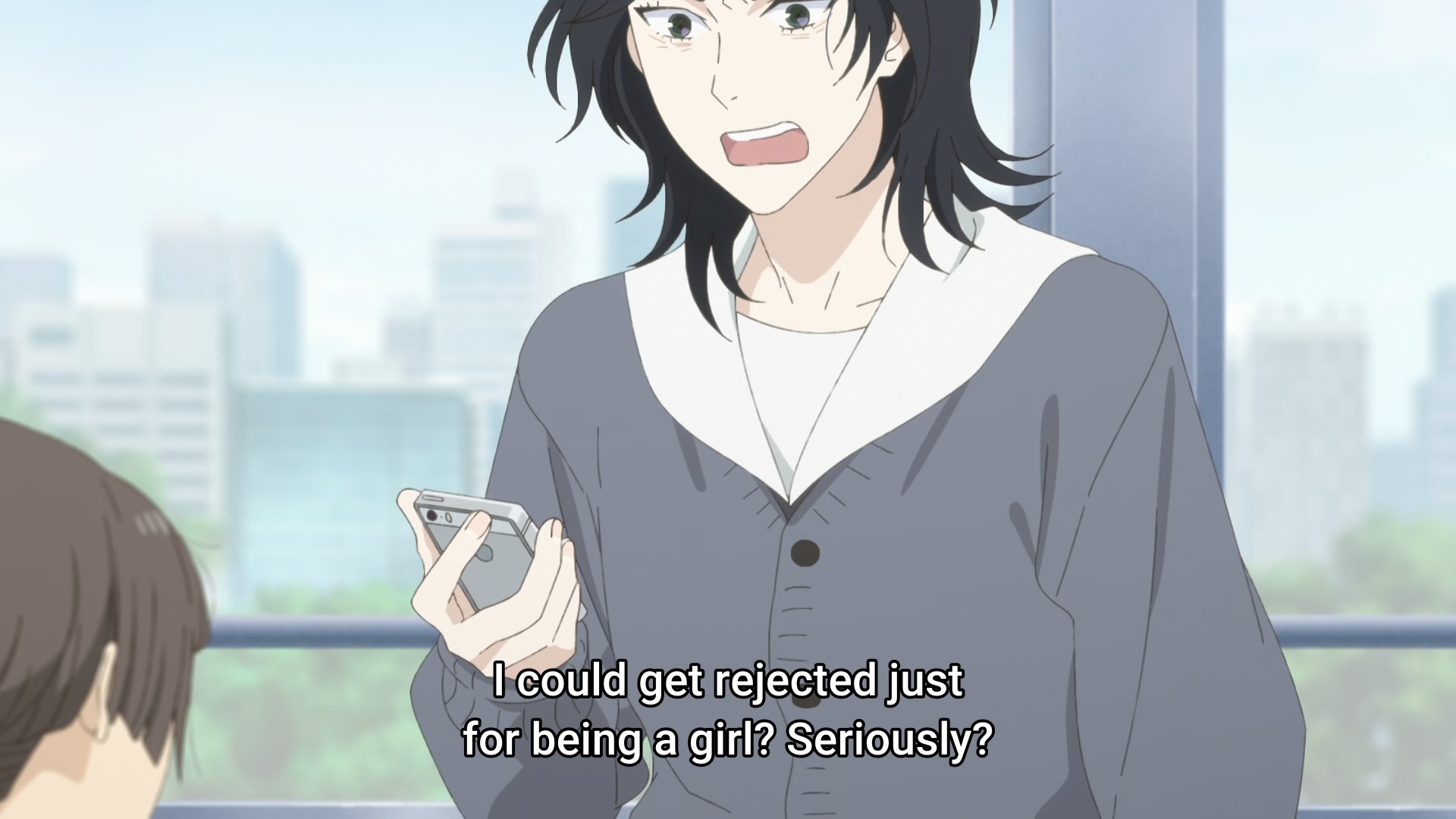
If you wondering what this scene at the beginning of episode eleven (and the end of episode ten) of Ikoku Nikki was all about:

A high school girl looking at her phone in outrage, saying 'I could get rejected just for being a girl? Seriously?'

Morimoto Chiyo is one of Asa’s classmates, a hard working, diligent student. Top of her grade, she’s ambitious and has plans to study medicine and become a doctor. So far the anime hadn’t spent that much time on her. She was introduced in episode four as the representative for the new class of first year students. Apart from that she was occasionally shown talking to Togo Yuto, a huge football player also in Asa’s class. Just one of the incidental characters drifting in and out of Ikoku Nikki‘s story or so it seemed.

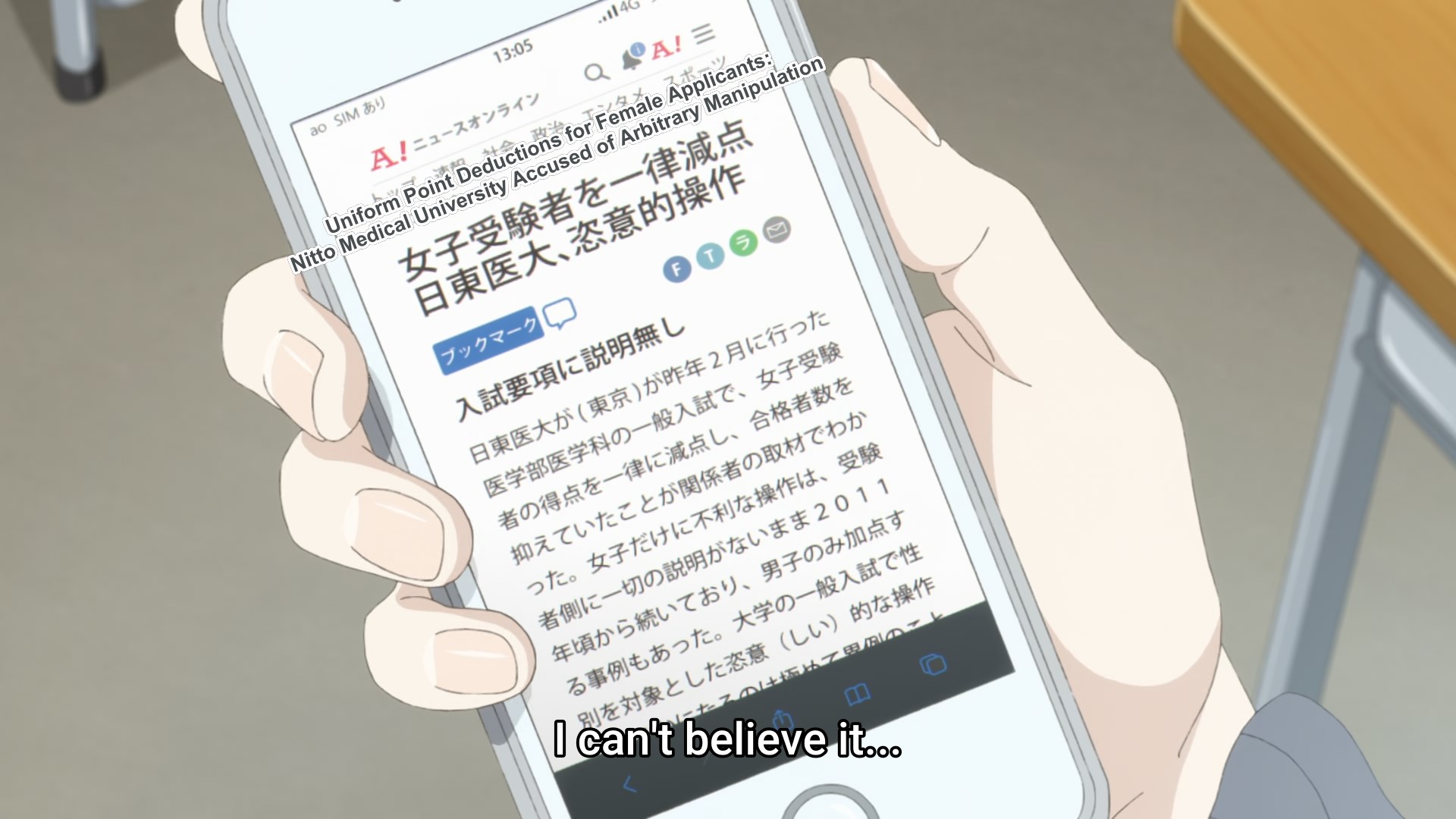
A close up of a phone screen  showing 'Uniform point deductions for female applicants: Nitta Medical University accused of arbitrary manipulation'

What’s she’s reacting to isn’t something made up for the series. Back in 2018 a huge scandal broke out when it was revealed one of the top Japanese medical universities had had deliberately set a quota of no more than thirty percent of its annual intake for female entrants:

It quotes an unnamed source saying officials adopted a “silent understanding” to reduce the number of female entrants over concerns female graduates were not going on to practice medicine in employment.

“Many female students who graduate end up leaving the actual medical practice to give birth and raise children,” the source told the newspaper.

The way it did this was by falsely reducing the scores of female exam takers and had been doing so since 2006, while also inflating the scores of male applicants who had donated to the school. Even in a country where societal expectations are indeed still are that women will only work until marriage, this was still a huge outrage. Chiyo’s anger here was and is widely shared, with various female authors responding to it in their stories that year and the next, the most well known probably being Sexiled, where a similar conspiracy is uncovered in the Adventurers Guild. The scandal was an insult to all Japanese women. It wasn’t just that society treats you as if marriage and children should be your highest calling, expects you to sacrifice your career for it, now these same expectations were used to deny you the chance altogether. With Ikoku Nikki the manga having started a year before the scandal broke, it’s unsurprising that Yamashita Tomoko too would incorporate it in her story.

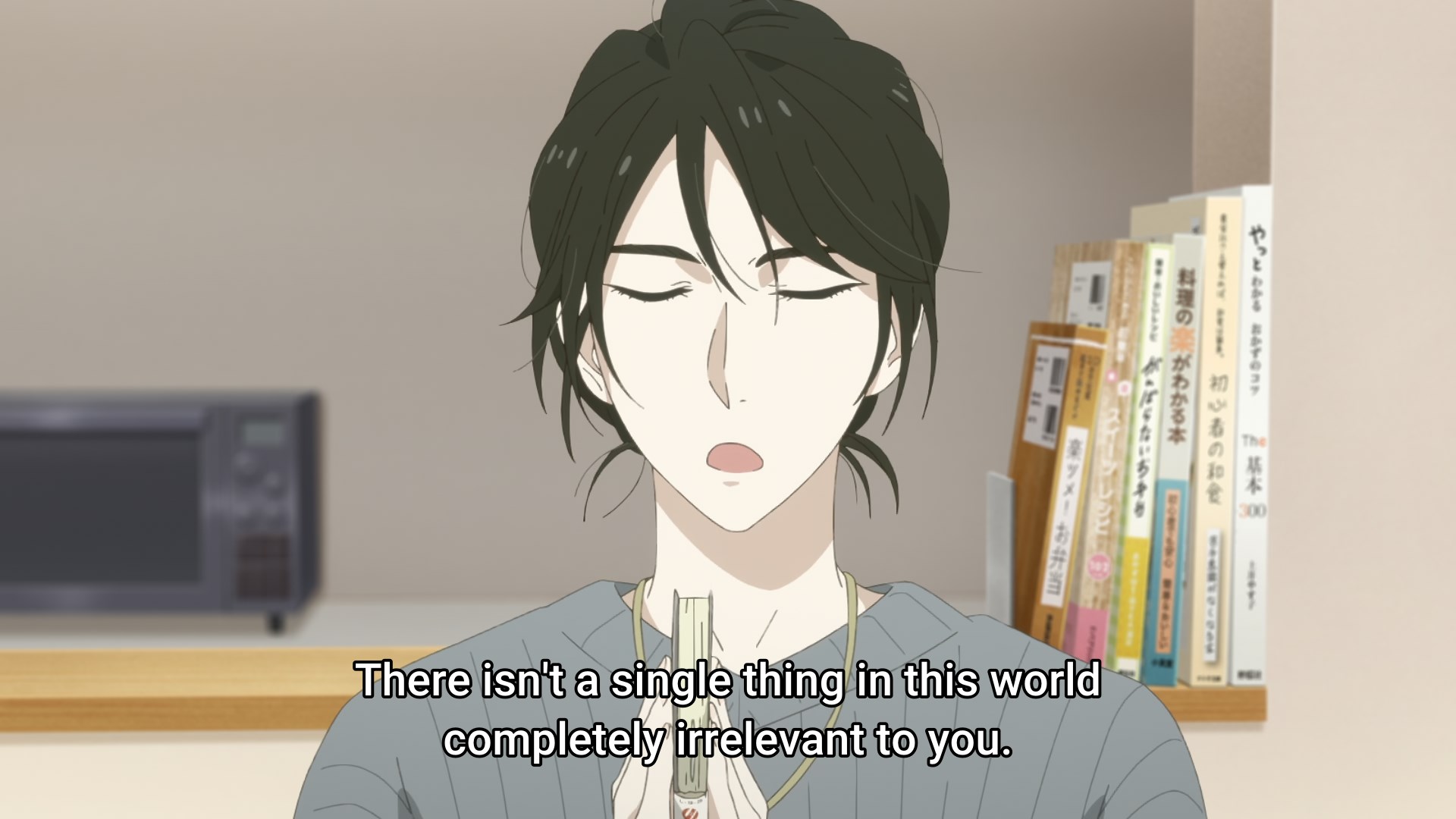
There isn't a single thing in this world completely irrelevant to you says Makio to Asa, closing her book

And it fits so well too, even if it’s not directly relevant to Asa as it clearly is to her classmate Chiyo. As Makio tells Asa in episode eleven, “There isn’t a single thing in this world completely irrelevant to you” after all. One of the themes of the manga and the anime both have been her wrestling with the “infinite possibilities” that lay ahead of her afterall, of knowning at fifteen what you might even want to do with your life. Wanting to become the person you want to be but not necessarily knowing yet who that is. And here is Chiyo, who does know who she is and what she wants to become, having her nose rubbed in the fact that there are people deliberately setting out to make that impossible. It’s not as if this series offers a particularly naive or rose tinted version of growing up, but it’s still a painful dose of reality slamming down on it.

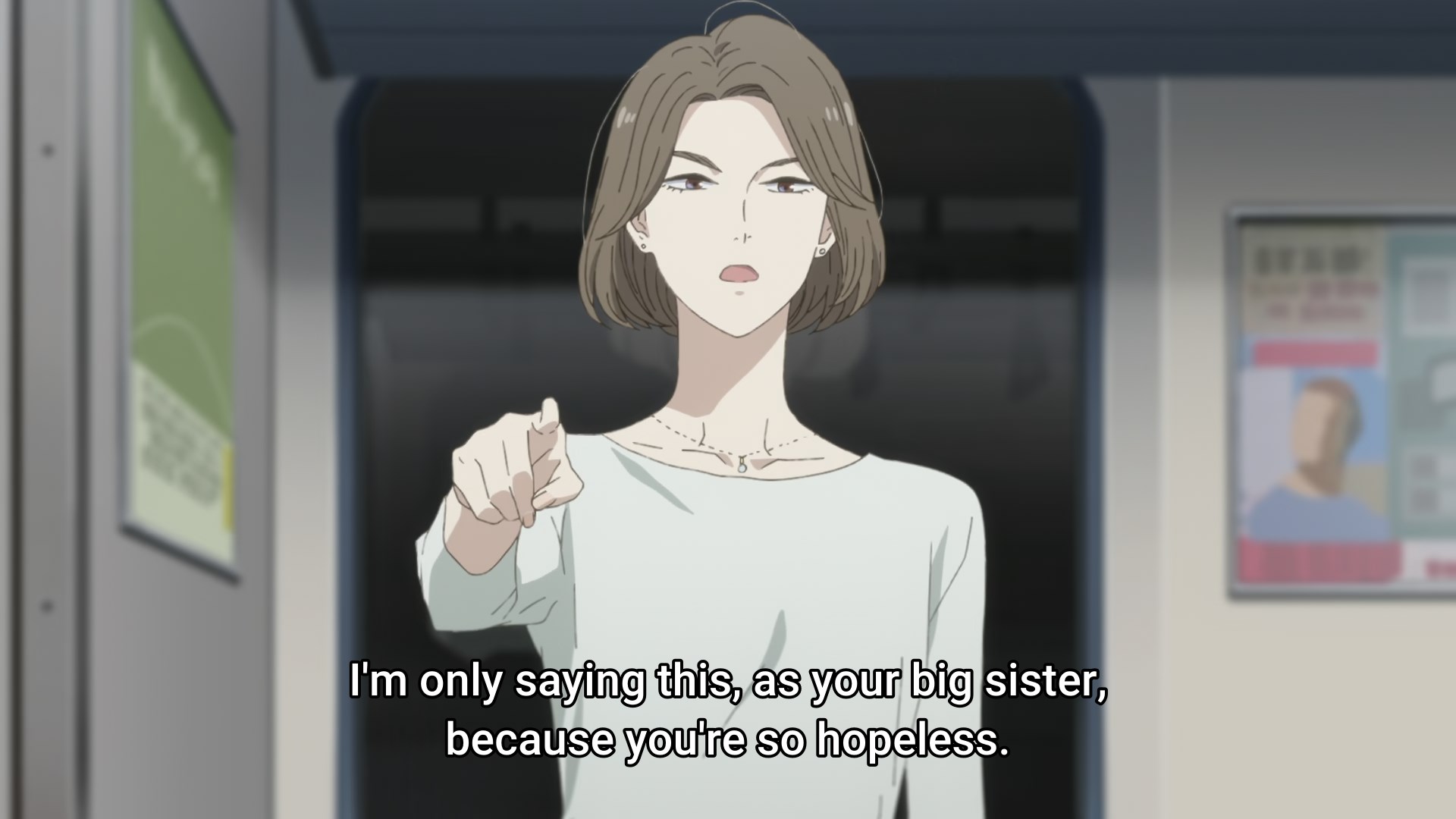
I'm only saying this, as your big sister, because you're so hopeless: Minori point her finger at the camera, addressing Makio

Now obviously this wasn’t planned; the manga started a year earlier after all, but that’s the genius of serialised manga, that it can incorporate such contemporary issues so quickly when the mangaka is up for it. this is a series which is partially driven by the conflict between Makio — unconventional, neurodivergent, not afraid to go her own way — and her older sister Minori, always seeking the societally approved way of doing things. Makio had to constantly fight her sister about how what she was doing was wrong, or strange, or couldn’t work to the point she still haunts her after hear death. Yet Minori could only argue with her, never force her to give up her ambitions, the way Chiyo’s could’ve been crushed by this conspiracy to deny women access to medical university. The scandal brings to the surface a feminist undercurrent that had always been lurking in the series, some of which we already say in episode nine. That manipulation of exam results is the ultimate expression of what Minori used to tell Makio: “we know better than you what’s good for us, so if you don’t listen, we will make sure you do what’s best for you”.