Should Corbyn stand as an independent?

So Jeremy Corbyn has had the whip withdrawn from him for over a year now and this weekend Labour made noises about appointing somebody else to stand in his constituency in the next elections. That of course immediately started speculation about whether or not he should run as an independent or start his own party. There’s little doubt that Corbyn could do this and very likely would win as an independent, but would he do so?

That’s the real question: would Corbyn want to stand in election again in the first place? The man’s seventytwo now, would he want to be in parliament for another five years, pushing eighty at the end of it? Or would he rather spent his time on activism outside of parliament, via his new Project for Peace and Justice? If denied to stand as a Labour candidate, would Corbyn have the will to stand as an independent against his old party? Nothing in his history suggests he has anything but a deep abiding loyalty to Labour even when the party has no loyalty to him or his ideals. He has never shown that sort of spite that could compel him to ‘wreck’ Labour like that.

The other question is what it would accomplish, other than schadenfreude when some parachuted in Starmeroid inevitably loses their deposit? Could a hypothetical left of Labour party build on a Corbyn win in the next elections, or would it be just a stunt, ala Galloway and Respect? Is it actually worthwhile to pursue a parliamentary solution or should the left’s energy be more constructively used outside it, in the unions for example? Is there the infrastructure in place to make this more than just the Corbyn show?

Anti-Idol industry Idol story: Selection Project — Anime 2022 #006

I have to admit, the ending of the first episode of Selection Project had me completely fooled. It seemed to be pointless drama, a cheap way to inject some tension into what seemed a foregone conclusion. As we follow our protagonist Miyama Suzune through the regional finals of the 7th season of the Selection Project, she seems to have it in the bag. We get flashbacks to her as a little girl stuck in hospital, listening to the winner of the first Selection Project, wanting to be an idol as well but knowing it’s impossible. We get to see her say goodbye to her family to go to the regional finals, where she meets up with the other candidates. It’s clear by the focus on her that she’s the best of the four candidates and will win easily. But then when she sang her song, this happens:
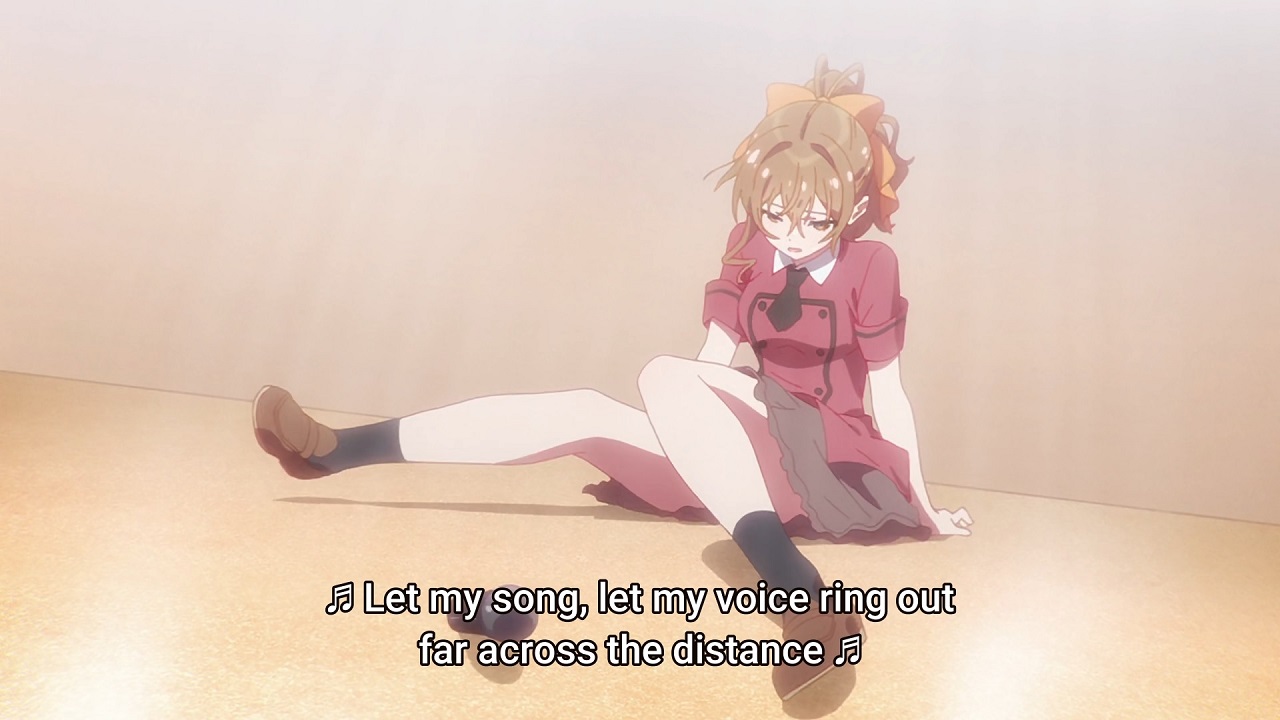
Our protagonist falls down while singing

I always dislike the sports anime gimmick of having your protagonist lose because of a conveniently timed injury. What’s worse, in the very next episode it was resolved by having the actual winner drop out and Suzune taking her place as the runner up. I did not understand why this was needed, why this plot development was necessary. That’s because I was treating it as a standard idol competition show, rather than what it actually was: an anti-idol industry idol show. A show where everybody wins, everybody is friends and everybody is an idol:
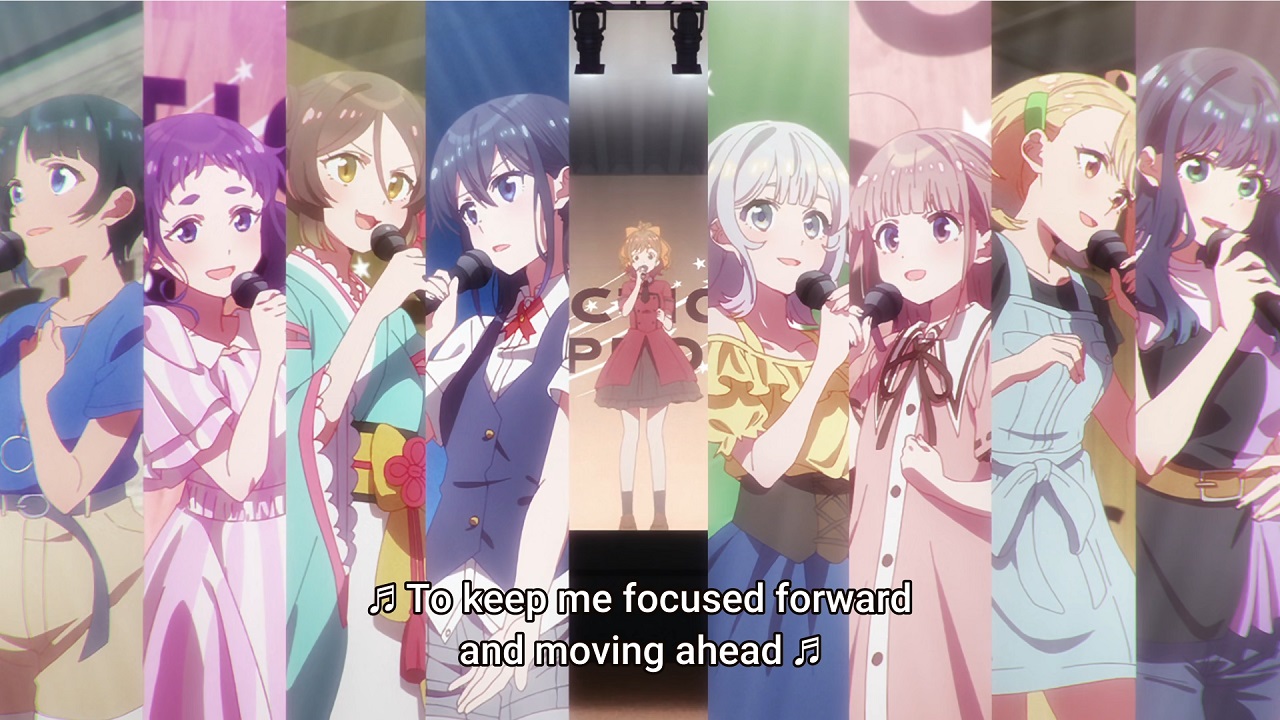
All the Selection Project finalists singing

Hang on, that sounds familiar. That sounds a lot like the Hibiki arc in PriPara season 2. In PriPara every girl could be an idol if she wanted to, until super idol Hibiki challenged that by arguing that no, only those with real talents should be idols and the rest should be content just watching it. And that’s exactly the attitude of a idol talent show like the Selection Project: there can only be one winner. And just like PriPara did, so too does Selection Project prove this attitude wrong.
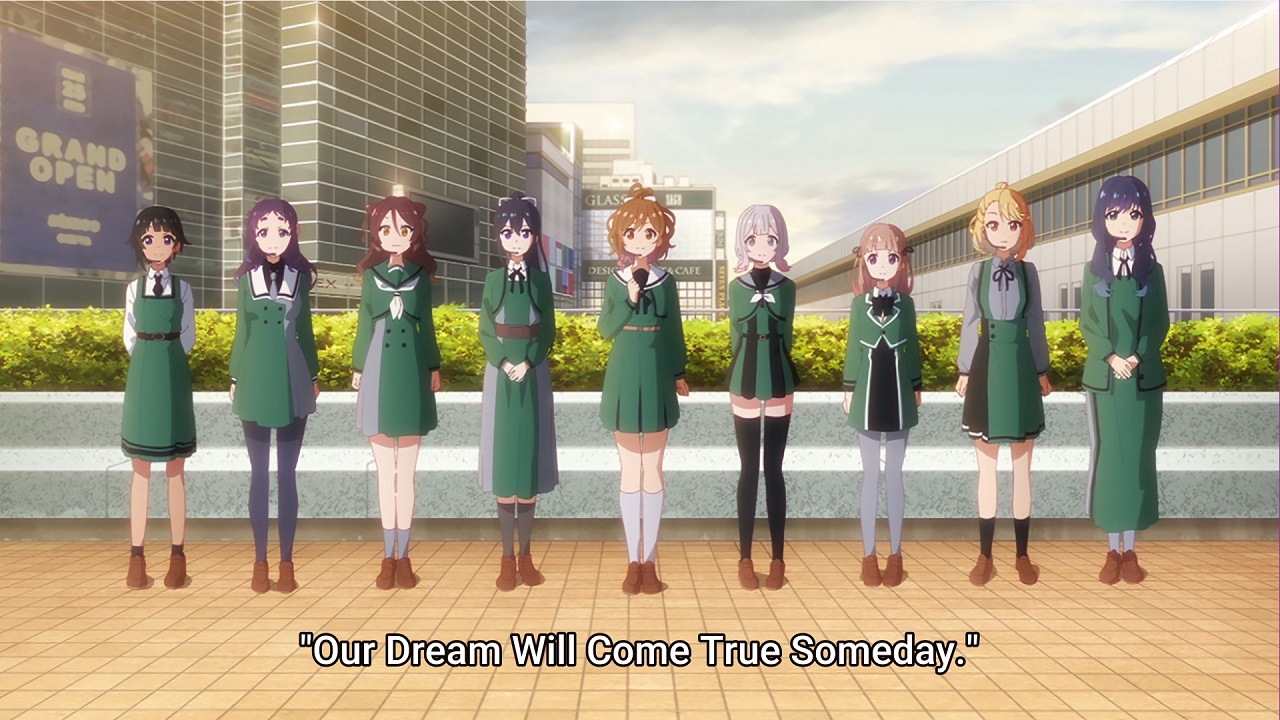
9-tie in action

You know how these shows are supposed to work. With every new challenge, every new stage some candidates are supposed to drop out. But here this never happens. Everybody wins, everybody survives. Even when in the final stage the nine girls are forced to vote themselves who needs to drop out, it doesn’t work. They all get disqualified because they all vote for themselves. And not even this is the end: the girls form their own, independent idol group called 9-tie (cutie) and hold street performances until they get big enough for the Selection Project production company to invite them back to hold the finals as a group rather than as rivals. Yes, of course this is all a very idealised view of the industry, but it works.
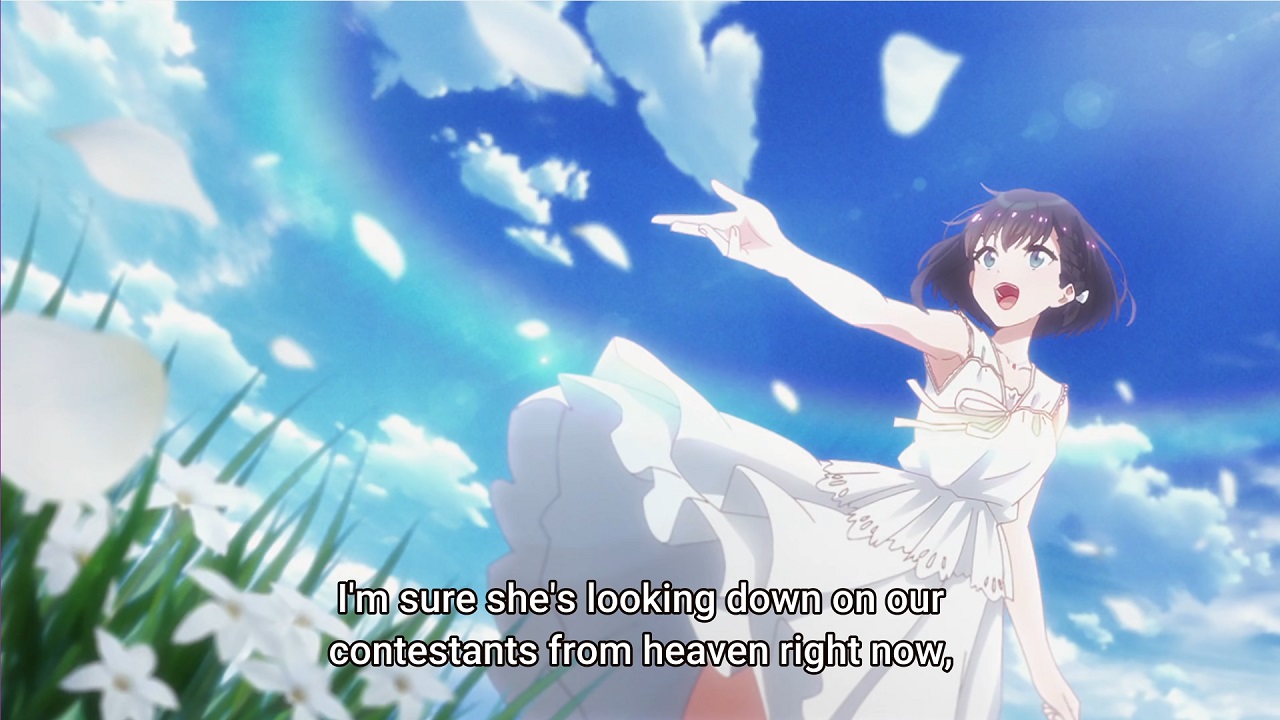
Legendary idol Amasawa Akari

What gives this series its hear and why I should’ve trusted that Suzune’s convenient fainting was more than just cheap drama, is the relationship between her and Amasawa Akari, the idol who won the very first Selection Project. Akari died in a car crash three years ago and had been Suzune’s inspiration. For one of the fellow contestants though she was more than that, she was her sister. And Suzune has to team up with her, becomes friends and discovers just how much of Akari is in her. Suzune’s medical condition, the reasons why she was in hospital and how it still impacts her now, all are important and that convenient fainting was just the first hint of that. All of it is tied up with Akari and her younger sister and the way how is in hindsight very obvious, but again it worked.

Snow & Steel — Peter Caddick-Adams

Cover of Snow & Steel


Snow & Steel: the Battle of the Bulge 1944 – 45
Peter Caddick-Adams
872 pages including notes and index
published in 2014

Nuts!

The story of the Bulge should be familiar. Hitler’s last roll of the dice, an offensive that nobody expected. The goal: to split the western allies apart by reconquering Antwerp. Elite panzers racing through the Ardennes, reliving the glory days of May 1940, expecting little resistance from the outnumbered and inexperienced American forces stationed there. the allied airfoces, grounded by bad weather and unable to come to the rescue. The unexpected resistance and Hitler’s hopes smashed at Bastogne, when after an imperious demand to surrender now the town was surrounded, the commanding American officer responded with a simple “Nuts!”

It’s a great story, a story the town of Bastogne dines out on to this very day. When I was there on holiday last October literally every second shop window had something about the siege in its display. It also has the benefit of being mostly true. But it isn’t the entire truth of the Ardennes Offensive, or Peter Caddick-Adams wouldn’t have needed almost nine hundred pages to tell its story. There were other sieges beside Bastogne, other places where American resistance held up the Nazi attack long enough for it to ultimately fail, other tales of heroism and tragedy to be told. Arguably, one could say that the fate of the offensive had been determined long before Bastogne had even been reached. Similarly, the story didn’t end when the siege of Bastogne was lifted. There was more hard fighting to be done, fighting which lasted into January and February of 1945.

Read more…

Rough start but worth it: Maidragon S — Anime 2022 #005

This is what I watched Kobayashi-san Chi no Maidragon S for:

Kobayashi-san Chi no Maidragon S, sequel to 2017’s Kobayashi-san Chi no Maidragon, is an important series for Kyoto Animation: the first broadcast since the arson attack that killed 35 employees in 2019, including first season’s director Takemoto Yasuhiro. The studio can be proud that even after this horrfying event they could still maintain the high quality of animation that it became know for. Watching it with the knowledge that some of the people who had worked on this or would’ve worked on this had instead died in a senseless attack made for a somewhat bittersweet experience.

What made Kobayashi-san Chi no Maidragon S difficult for me as well were the first two episodes, which introduced new dragon Ilulu. At the end of the first episode Ilulu gave Kobayashi a magical penis, which was one of the more annoying storylines from the original manga and not much better here. Therefore I stopped watching this when it was being broadcast after the second episode and only binged it a few days ago.

Once that was settled though this was once again more Maidragon goodness. With the cast now fully established, most of the episodes focused on the interactions between the various dragons, Kobayshi and their other human friends. Ilulu for example got a part time job at a candy store where she worked with the 16 year old grandson of the store owner and their interactions were both funny and sweet. We also got more insight in the history between Tohru and Elma, who turned out to have been friends in the other world, as well as the reasons why Tohru turned up in Tokyo in the first place. Most of the best episodes revolve around Kanna though, who is still as adorable as she was in the first series.

Magical realist slice of moe: Fuujin Monogatari — Anime 2022 #004

I’ve never seen any anime with the same art style as Fuujin Monogatari. I’ve also never seen an anime which nailed how cats look and move as perfectly as this series does. Most anime are content with just moeblobs and some poor voice actor doing a bad imitation of a meow, but not this show. Just look at them. Those are cats with character.

Our protagonist Nao was on the roof to take pictures of clouds when she saw that cat jumping off the roof and catching the wind, surprising her so much she falls off herself. It would be a short series had she not survived this and she was indeed saved by the teacher, Taiki-sensei, walking the school grounds who, like the cats, turns out to be a wind user. Nao isn’t the only one who knows this; there’s Ryouko, who has a habit of feeding the cat Nao found on the roof and who has learned a bit about using the wind from Taiki-sensei. Together with Nao’s friend Miki, the only other member of the Digital Camera Club and her boyfriend Jun, they start experimenting with wind manipulation.

Fuujin Monogatari is basically a Slice of Moe/Cute Girls Doing Cute Things show with no real overarching plot. The girls practise their wind powers and go on small adventures in and around the school using them. The wind magic itself is never explained, it just exist and some people can use it, most cannot. In one episode for example the girls meet a bunch of elementary school boys who also have these powers and use it to play kick the can. The closest show it reminded me of was Flying Witch, which also grounds its magic in the more mundane world surrounding it. Where it differs is that the wind magic of this series is far more random than is usual for anime. Normally there would be some shadowy magical organisation, or the magic is rooted in Japanese folklore and mythology, but here wind control just happens to be something some people and cats can do.

What makes Fuujin Monogatari from a good into an outstanding anime is ultimately its unique art style. This might have worked with a more generic art style, but not half as well. It’s not glossing up a somewhat dull premise with a lick of style; it’s the integration of the art style with the story and the world it takes place in, the way it works so well to depict wind that makes this great. Like the best Shaft anime, you cannot separate style from function.