Line goes up…

If you wanted to know about NFTs, where they came from, what they’re being used for and especially why they are harmful but were afraid to ask, this is the video for you.

At almost two and a half hours it’s a long sit, but that’s because Dan Olson takes the time to set the context in which NFTs arouse. To understand NFTs you have to understand Bitcoin and all the other electronic currencies that were inspired by it, not to mention the dreaded blockchain and the whole spectre of ‘web3’ technology. As important, Olson understand that just knowing the technological context isn’t enough and therefore starts with the real driving force behind Bitcoin and NFTs: the 2008 recession.

Because in 2008 the world economy crashed and while it may superfically look like the world has recovered since, the truth is it wrecked the opportunities of an entire generation. The idea that if you get the right education, go on to get a good job you can have a good, stable career the way your parents could in the sixties had been undermined for decades of course, but the 2008 recession made it official. The ladder had been pulled up and the normal ways of bettering yourself are no longer available. Even people lucky enough to graduate and start a middle class career are finding life precarious; you may be temporarily affluent but are you secure the way your parents were secure in their careers? And it’s not just careers that are insecure: something as basic as owning your own house is increasingly out of reach of all but the most upper of middle class people. Be it London, new York or Amsterdam, it’s hard to find a house when investors routinely overbid you. The average housing price here in Amsterdam is now 10,000 euros/square metre, which means my own appartment of 48 square metres is worth half a million euros. It’s absurd.

All of which means is that life is as unstable as it has ever been since the 1930ties for the vast majority of people even in rich countries, the gap between the rich and the rest of us as great as it ever has been while ever attempt to level this gap has been smashed. We’ve seen how the establishment in the UK reacted when Jeremy Corbyn almost won the 2017 elections, which led to the Labour right smashing their own party while the entire press conspired to put Johnson in Number 10. When regular politics are no longer allowed and regular ways to have a stable career and life are equally smashed, that leads to people looking for alternatives. In politics, this lead to Trump and Brexit. Similarly, if people cannot get rich conventionally, they’ll seek out other ways of doing so. There’s a huge market of precarious, affluent middle class people ripe for exploitation.

Which brings me to Albania. A former ‘protectorate’ of fascist Italy, after liberation at the end of the Second World War it became a communist dictatorship ruled by Enver Hoxha. Hoxha was a Stalinist so orthodox that he broke with the Warsaw Pact for being too soft. Under his leadership Albania was so closed a country it made North Korea seem positively welcoming. The collapse of communism all over Eastern Europe also reached Albania and in the early nineties it became a normal democratic, capitalist state. Now if you know your recent European history, you know that all these countries that had lived under communism for almost half a century were incredibly vulnerable to capitalist exploitation and were plundered on an unprecedented scale by their own ex-communist elites and western advicers. Albania was worse than most and its economy became dominated by pyramid and ponzi schemes, with millions of people investing their savings in them. When it all collapsed in 1997 it led to civil war.

As Dan Olson argues here, all electronic currencies are pyramid schemes, people buying them to sell to a bigger fool and NFTs even more so. There’s a ready made market for them, of those precarious middle class, usually tech adjecent people who want to find a way to get rich or die trying. Which is worrying. It’s not just the godawful realities of bitcoin and NFTs, it’s that once it all burst, once all these people, already primed by Trump and Qanon, lose their shit, they’ll lose their shit and what will that mean for America?
Get in the Robot Kazuki: Soukyuu no Fafner — Anime 2022 #007

Stop me is this sounds familiar. Kazuki is a high school boy on Tatsumiyajima, a small Japanese possession somewhere in the Pacific. Life is peaceful but a bit boring on an island where everybody knows everybody. That is until — just as his childhood friend Soshi has returned from a trip to Tokyo — the island comes under attack from enigmatic aliens called Festum. Turns out the peaceful world Kazuki and his friends knew is a lie, most of the world has been overrun by the Festum and now Kazuki has to pilot the only thing that can defeat them: the Fafner mecha. Mysterious all powerful alien monsters that cannot be reasoned with, giant robots as the only way to defeat them and reluctant child soldiers drafted into a secret war as part of a worldspanning conspiracy their parents are involved in. Yes, Soukyuu no Fafner: Dead Agressor does own a lot to Neon Genesis Evangelion. Not just plot wise, thematically too, with its innocent teens being dragged into the conspiracy filled adult world where nothing is what it seems, accompanied by lashings and lashings of angst.

Soukyuu no Fafner was a hard series to like. First aired in 2004, it’s smack in the middle of anime’s ugliest period. Anime was transitioning from traditional, physical cell based animation towards computer based cell animation, which led to a general loss of quality across the industry in my view that only improved once the animators got to grip with the new technology. Fafner also features the then current trends in character design, which again I find some of the ugliest to have existed in anime. Combine that with the ‘brown equals realism” colour palette trendy at the time and you get a series that isn’t that visually appealing to look at. This may explain why it took me three tries to finish this series. I first started watching this in 2016 and got to episode 11 before abandoning it. Retried two years ago and got to episode 14. Finally on the third try I decided to restart where I left off and binged the last eleven episodes in a day.

Sometimes you have these sort of series. It takes a couple of times for it to click; ironically I had the same issue with Evangelion. In Soukyuu no Fafner‘s case once I persisted I rather liked it, the second half especially once the true scope of the story was revealed mand some of the Evangelion influences dissappated. I wouldn’t call it a classic but I understand why it became somewhat of a cult favourite. There would a television special prequel in 2005, a movie in 2010, another tv series in 2014 and a series of movies only last year; it has a following at least. Not sure if I’m eager to see any of these follow ups, but I don’t feel like I wasted my time watching this either.

The sheer hypocrisy

You can’t help but sympathise with the guy being interviewed here, a funeral officer who at the height of the Covid pandemic had had to stop people from saying their last farewells, now feeling a fool for having done so when the government that set the rules never had any intent to obey them themselves

What sticks in the craw is that’s James O’Brien he’s talking to, who with his employer LBC was one of the people responsible for destroying the one credible alternative to a Johnson led Tory government back in 2019. What sticks in the craw is that all of the press currently falling over themselves to explain what a bad ‘un Boris Johnson is and who could’ve guessed, could’ve told us that in 2019 but refused to. What sticks in the craw is the pretence that having an office party is what made Johnson bad, that the failed and utterly corrupt covid strategy of the government as a whole isn’t an issue. That for the second time in a decade the Tories are responsible for mass deaths amongst the most vulnerable, first through austerity, second through herd immunity is ignored or outright denied even. But the chance at taking down a prime minister who has become an embarassment without doing damage to the larger Tory project by using this trivial issue has the same people who championed him two years ago chomping at the bit.

First Cameron, then May, now Johnson. The media install Tory prime ministers to do their dirty jobs, then discards them when no longer needed, but never questions the legitimacy of the Tories as a whole. That fate is left for anything that challenges the established order. Tell me, if democracy means that the press is allowed to ruthlessly monster anybody they take a dislike to, that only those candidates and parties acceptable to it are allowed anywhere near power and that allowance can be withdrawn at any time, how much of a democracy is the United Kingdom still?

Grief is still weird — Friday Funnies

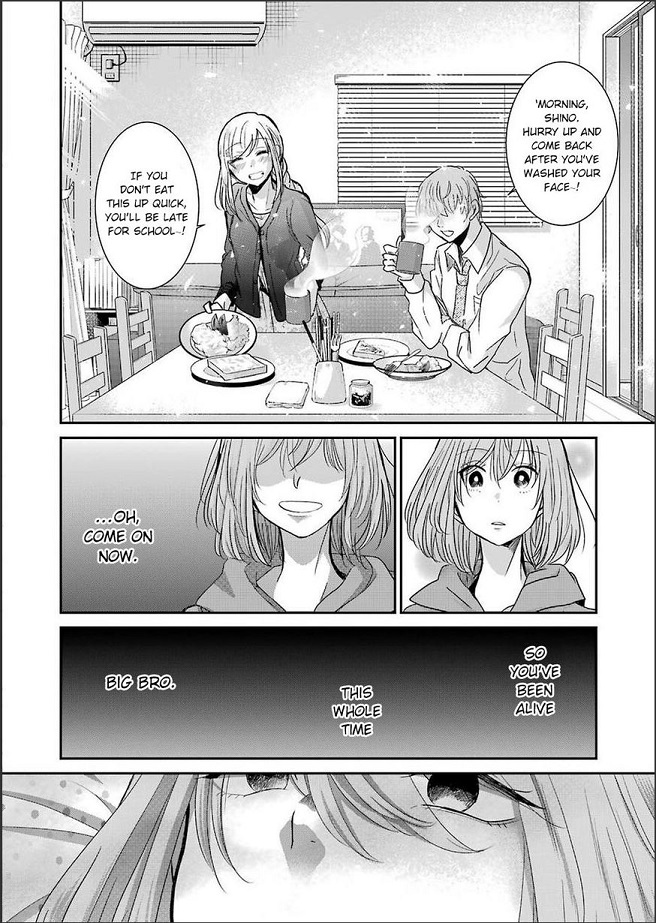
I’ve had dreams like this. Dreams in which Sandra was alive and I realised halfway through that hey, shouldn’t you be dead? Never quite sure which ones were worse: those, or the ones in which I only noticed after waking up. The dreams itself weren’t bad, just the same mix of anxiety dream and vague memories of living together in a house we’ve only lived in in dreams. It’s just the realisation that this is not real that hurts. No surprise than that this page from chapter 67 of Kuzushiro’s Ani no Yome to Kurashite Imasu / Living with my Brother’s Wife hit me raw.

A manga page showing a girl seeing her dead brother eating breakfast and getting excited he is actually alive before waking up

Kishibe Shino is a seventeen year old girl whose married brother died six months ago, leaving her as well as his wife and her sister-in-law Nozomi behind. She has no other family, her parents having died when she was much younger. Therefore she’s living together with her sister-in-law, determined to not be a burden to her, while she is equally determined to be a shoulder Shino can lean on to. Most of the series is Shino and Nozomi learning to live together as a family when all they had in common was the person they’re both still mourning. Grief is an understated, but continuous presence in the story and around chapter 67, from which this is taken, the story has progressed towards the one year anniversary of his death. And because most of the story is centered around two awkward people learning to form a family together, with their grief in the background, chapters like this that center it, hit that much harder.

Is Akebi-chan fetishistic? Is it bad if it is?

Akebi-Chan No Sailor-Fuku is a simple story of a girl from what even the cast of Non Non Biyori would call the sticks, who has spent the entirety of primary school being the only pupil in her class, going to the middle school of her dreams. A school her mother also attended, where she will finally get to wear a sailor uniform. She always wanted to wear one because her favourite idol wore one as well. And then it turns out the school uniform changed to blazers years before. Whoops. Luckily the head of the school allows Akebi-chan to wear her sailor uniform anyway, seeing as how much she wanted to and how much work her mother put in it to create it. That’s basically the first episode, but that simple story isn’t what you watch this show for. No, it’s the sheer pleasure and joy with which Akebi-Chan No Sailor-Fuku shows off its protagonist’s physicality, the confidence with which hair, clothing and body movement are animated:

Much of the craft shown in this first episode is explained by the presence of Megumi Kouno, who e.g. animated some of the best sequences in the original IdolM@ster series. It all looks great, a standout in a season full of duller, by the numbers series, but there’s something slightly uncomfortable about it. As Alex Henderson noted in their review it all feels a bit fetishy?

I’m sure it’s not an aspect that everyone will notice, and it’s not an aspect that will detract from everyone’s experience with the show. And it’s a fraught topic to discuss, because it’s not “fan service” in the traditional use of the word, not explicitly sexual imagery or framing or placing the female characters in compromising positions. There’s a scene of Komichi and her little sister in the bath together that manages to be very frank and un-leery about their nudity, which I was impressed by until I started noticing other things that the storyboarding did focus on with an adoring intensity: an extra-shiny pair of lips here, an extra-crinkly piece of fabric against a girl’s body there.
Then Komichi walks in on a new classmate mid-pedicure, and this habit becomes hard to ignore. And it… complicates things, because I genuinely do want to praise this show for its use of visual storytelling and characterization. I want to nod and smile and say this show did a great job using the visual medium to provide a window into the emotional day-to-day life of a pretty authentic-feeling young teen girl. I want to be able to celebrate the intricate, intimate picture this premiere builds without wondering if all this detail was put there for as fetish fuel for someone.

There’s nothing of the usual fanservice in Akebi-Chan: no leering camera angles, no accidental groping, no overtly emphasises busts or butts, nothing that we’ve learned to recognise as fanservice. Akebi-chan’s clothing, including her sailor outfit is more practical and far less sexy than that of most anime school girls. When there is nudity, it’s non-sexual: Akebi taking a bath with her little sister, Akebi trying on her new uniform. And yet…

Is it because we’re trained by other anime that we see some of this as fetishised, as sexual, like the pedicure scene Alex mentions? Or is this fetishistic but in a way we’re not familiar with? And if so, is this bad? Having read through the manga after having seen this first episode and pondering Alex’s review, I can’t help but think that it is the mangaka’s fetish, their obsessions that makes the series what it is. There are entire chapters that are little more than an excuse to show off Akebi in movement, dancing or running or playing. The author seems obsessed with making sure the way her clothing and hair move are as pretty as possible. To choose a girl in middle school seems dodgy, but it never quite felt sexualised for me? It’s more like the artist just likes to draw pretty people, something that becomes very clear with Akebi’s father, who looks like the sort of fifties deep in the closet sports hunk.

For me, if this is indeed the result of the author’s fetishes, I can live with that. Reardless of the author’s intentions, it doesn’t come over as wank fodder. What attracts me in both the manga and the anime is the beauty of bodies in motion and the way it’s depicted for me stays on the right side of creepy. Your mileage may vary of course; I can well understand that for other people this is too fetishistic, too reminiscent perhaps of how some people look at you in real life.