Watame’s lullaby — Hololive Showcase

Watame has such a great, soothing voice:

Hitsuji mofu mofu / Kedama moko moko
Watame fuwa fuwa / Do do do do
Futon ni kuru mari / Kyou mo oyasumi

Ashita no koto de / Doki doki shitari
Sowa sowa shitari / Shinai de
Yukkuri nan ni mo / Kangaenai de nee you
Nemure nai yoru ni / Yorisou hitsuji ga
Beeeee iru yo
Atatakai miruku ni / Hachimitsu ga tokeru yo ni
Good sleep sheep sheep

Hitsuji mofu mofu / Kedama moko moko
Watame fuwa fuwa / Do do do do
Futon ni kuru mari / Kyou mo oyasumi

Tsunomaki Watame is supposed to be a sheep, singing you to sleep. Well, it works for me. In general her streams are soothing enough already, let alone like here where she deliberately tries to put you at ease.

The limits of Owen Jones

Oliver Eagleton exposes the limits of Owen Jones and puts the boot in hard in his review of Jones’ new book on the failure of Corbynism:

Of course, Jones is most aligned with his Guardian colleagues on The Antisemitism Crisis (which he places centre-stage, awarding it more coverage than any other topic). Here again, press relations are the overwhelming concern—a fixation evidenced by the semantic fluidity of the term ‘crisis’. Sometimes Jones suggests that antisemitism had reached crisis-levels within Labour; sometimes he describes a pr crisis rather than a real one. A similar sliding of sense afflicts the word ‘failure’: it is unclear whether Corbyn failed to deal with a racist infestation, or failed to rebut a smear campaign—as if Jones cannot distinguish between the objective reality and the media representation. He accepts that allegations of antisemitism have sometimes been cynically deployed to gag critics of Israel, but he would presumably lose his column space were he to describe the charges against Corbyn as a politically motivated miasma. So instead he strives for ‘balance’ through a series of self-contradictions. Corbyn is a lifelong campaigner against antisemitism, yet he has a ‘blind spot’ on the issue. Only 0.3 per cent of Labour members were accused of antisemitism, yet it is a ‘crisis’ within the party. The leadership team vastly improved the disciplinary process, yet their response suffered from ‘a lack both of strategy and emotional intelligence’. The party produced a thoughtful pamphlet ‘designed as a political education tool for members’, yet it ‘never rolled out political education’. Alongside such incoherent formulations is a summary of Israeli history which ‘could have been written by Shimon Peres’, as one critic has remarked. The description of Israel’s foundation as a valiant socialist endeavour, worlds away from ‘settler-colonialism’, which subsequently degenerated under a series of reactionary leaders, is a rehearsal of liberal-Zionist hasbara that betrays scant engagement with scholarship on the region.

The inability or refusal to see the Labour antisemitism crisis as manufactured is the worst failure of Jones and people like them on the (soft) left. Being employed by The Guardian it is likely more the latter than the former, because his employer was such a major player in ginning up this crisis in the first place. Column after op-ed pretending NWO1488ILoveHitler tweeting something antisemitic had anything to do with Labour just because he said he was a Labour voter. Granted, Jones was one of the few nominally left wing voices in the UK media that even tried to argue against this, but in the end he still accepted the framing of Labour and Corbyn as inherently antisemitic.

Like almost every other pundit, Jones now has to keep up the pretence that this was a serious crisis, because to do otherwise would reveal his own culpability in the whole ‘scandal’. Less guilty than others, sure, but he still played an important role in it, by establishing the limits of acceptable criticism. Jones could say that the attacks on Labour were politically motivated or exaggerated the crisis, but not that the crisis wasn’t real. Even now we conclusively know how little substance there was to the allegations thanks to the EHRC report, Jones has to keep up the charade. That’s why his retrospective is so incoherent, because he cannot afford to admit the truth.

Larnell Lewis is sickenly talented

Michel is right. It’s unbelievable how talented Larnell Lewis is, that he can learn to play the drums to this song in the time it took him to fly to the studio:

<

The first I heard about Snarky Puppy too. It reminds me of Pierre Moerlen’s version of Gong, especially their first two albums, Gazeuse! (1976) and Expresso II (1978), fusion/jazz rock with lots of mellow brass, piano and bongos. Not the most innovative music in the world in 2021, but gorgous nonetheless. Certainly deserving to be listened to in more detail.

And, sickening as it is watching Larnell Lewis hearing “Enter Sandman” for the first time and immediately nailing the drums when you yourself struggled for three years learning to play “Twinkle Twinkle Little Star” on the guitar —badly–, you can’t deny the man’s talent. Not just in being able to play a song perfectly after hearing it once, but also in how he breaks it down beforehand while listening to it.

Poor… Tired… And Depressed on Planet Earth — Evan Dorkin’s Hectic Planet

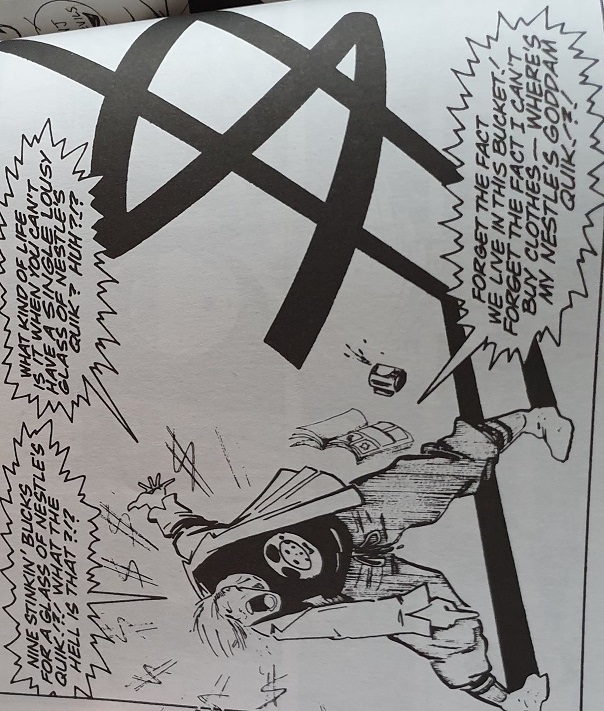
This is it. From Hectic Planet: Checkered Past this is the most Gen X comics panel ever created:

Hectic Planet: when you are so poor you cannot afford a glass of Nesquick

When you’re so poor, tired and alienated that the only thing you can think of to bring a little light in your life is a shitty overpriced chocolate milk substitute drink and you can’t even afford that. Welcome to Reagan’s America, except this is 2074 and what you’re reading is supposed to be a light hearted space opera sci-fi comic about underground Pirate Corps sticking it to the man. Instead it’s a series about twentysomething slackers with no jobs, no money, no future, living from day to day adrift in a world with no use for them. They survive on a diet of insipid pop culture references, underground zine culture and ska. Mix Clerks with Repo Man and 2-Tone and you sorta get what Hectic Planet was about.

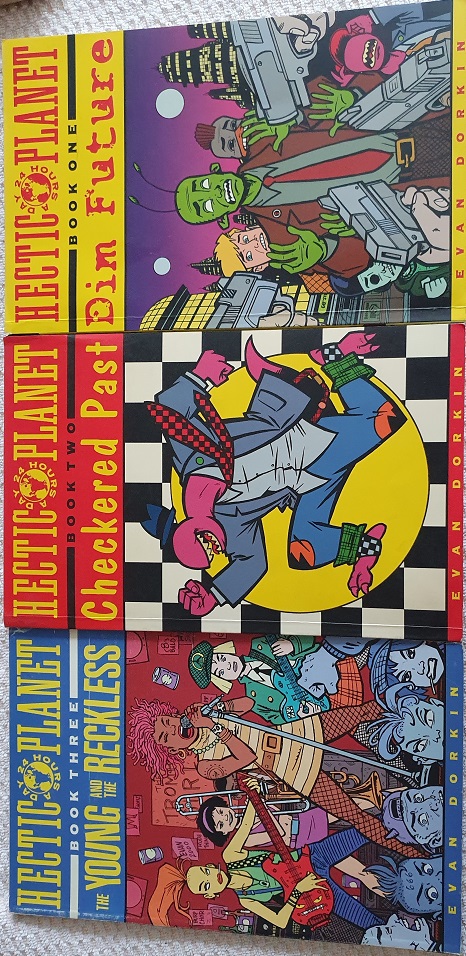
Hectic Planet: the covers of the collected editions

Hectic Planet was Evan Dorkin’s first series and it shows. The beginning is a bit rough but can see his art improving as the series progresses. Everything that he would later put in Milk & Cheese or Dork! is already here in an embryonic form. The density of the writing and art, the pop culture trivia, the background of quiet ennui & depression that’s present throughout brought on by the knowledge that there’s no place for you in the real world nor do you want one: this is perhaps the most Gen X comic ever created. Written in the late eighties, it anticipates the pop culture of the nineties, the depression after the false dawn of Reaganomics failed to turn into a mushroom cloud and a whole generation had to get used to the idea that they would have to become adults after all.

Trust him, he’s a doctor — Monster Musume No Oisha-San

I admire the efficiency with which Monster Musume No Oisha-San establishes its setting and let’s you know exactly what kind of anime it is in its first two scenes:

Remember the Monster Musume no Iru Nichijou anime that came out in 2015? Hapless nerd gets saddled with a veritable harem of monster girls living at his home through a combination of government incompetence and his own abnormal kindness. It was hugely popular at the time, but sort of got buried under the isekai boom a little later on, so we never got the flood of monster girl knock-offs I’d expected. Until Monster Musume No Oisha-San that is. It’s not that both are monster girl harem series, but that the exact same monster girls show up. Main girl is a lamia, her biggest rivals are a centaur and an arachne, while there’s also a mermaid and a harpy knocking about. Where it differs is in giving its protagonist, doctor Glenn Litbeit, a better excuse to meet monster girls, by making him a physician in a fantasy city who specialises in treating monsters. Also a good excuse for having him fondle, sorry, ‘examine’ all the monster girls he comes in contact with, most of which are presented with the same sort of soft core porn presentation as in the scene above.

So why should you watch this if you don’t think adolescent sex jokes like this are hilarious? Even if I personally don’t mind this, had light harem antics been all this series had to offer I wouldn’t be writing about it. What makes it interesting is the setting: ten years after a war between humans and monsters, in a city build to encourage human/monster cohabitation, ruled over by Skaldi, a literal dragon lady. She’s the one who forced the end of the war and settled Lindworm as a town where both humans and all kinds of monsters could thrive. It’s her health, after she suddenly collapses through a speech, that is the subject of the series last four episodes. What I immediately thought of, as I’m sure you did too, is Yugoslavia and the death of Tito. When Tito died in 1980, there were fears it could tear Yugoslavia apart; in the process it took another decade of nationalism, but you can see how it sprung to mind. Without lady Skaldi, would the town of Lindworm remain peaceful or would both factions fall back in their ancient hatreds?

No of course Monster Musume No Oisha-San doesn’t go anywhere near that. Instead, the plot is all about finding a way to handle her illness as well as convincing her she should not accept it as her fate to die just yet. But while it’s not explicitly mentioned, what that last story arc shows is the entire city, monster and human both, pulling together to save their beloved leader. It’s not a case of Glenn pulling a miracle out of a hat and saving the day all alone. Instead, he gets his old mentor, an octopus woman to do the difficult parts of the operation, trains an arachne woman to assist them both and gets a centaur girl he treated earlier in the series to make a set of needles that can actually handle dragon flesh. In the end, the dragoness who ended the war and created the city is saved by the people she did it for.

Ultimately, Monster Musume No Oisha-San remains a light hearted harem series slightly too fond of jokes too corny even for an eighties teen movie. For me however it manages to avoid most of the sleaziness of other fanservice oriented shows. I liked the various haremettes and it helps that all of them clearly have lives outside of their love/lust for Glenn, even managing to be friends with each other. an enjoyable way to waste an afternoon watching anime.