Rural Rides


William Cobbett – 542 pages – published in 1830

Cover of Rural Rides

If you’ve read any of China Miéville’s New Crobuzon novels, like Perdido Street Station, you’ve got some idea of what pre Parliament reform England was like in the late eighteenth andearly nineteenth century. It may have had a parliament and some semblance of a constition, but it was far from a democracy and it ruthlessly repressed any political movement that attempted to change things. Despite this repression there was a long and diverse tradition of reform and in the early nineteenth century there were few more impressive figures within the radical reform movement than William Cobbett.

Cobbett started his professional life by taking the stagecoach to London on a whim, spending several months as a clerk before becoming a soldier. In the army he got disgusted with the endemic corruption, brought charges against his officers and had to flee to France just as the revolution there broke out. He then spent time in the United States, until bankruptcy forced him back to England. At this point he was pretty much still a monarchist Tory in his political outlook, but this slowly changed towards Radical, especially after his conviction for treasonous libel after he protested the flogging of local militiamen by Hanovarian mercenaries.

In 1802 Cobbet founded his own newspaper, the Political Register, which ran until his death in 1835. During this entire time it was one of the most well known and consistent Radical publications, with a popularity unmatched by any other. In it, Cobbett agitated for Parliamentary reform and an end to the rotten boroughs and corruption, against the tax eaters, the clergy with their tithes and in favour of the honest working folk of England getting a decent living for their labours.

His politics in short were a mixture of genuine radicalism coupled with a nostalgia for a bygone England, where there were masters and labourers, but both with rights and duties towards one another. His ideal was an England of smallholders, small independent craftsmen and masters, each trading with another directly, without interference by capitalist middlemen. His sympathies lay mostly with rural England, rather than the cities.

Rural Rides is the logical outgrowth of Cobbett’s politics and sentiments, an attempt to discover the real state of the English countryside. Originally published in the Register, it covers a period of four years, from 1822 until 1826. Its strength, the reason why it is still in print is that it is not just a political examination, but a portrait of a countryside now long gone, still partway in its transformation from the medieval to the modern.

Cobett has a real love for this landscape, and a real hatred for the pressures that are transforming it or have transformed it. Furthermore this love is coupled with an admiration for the people who inhabit it. Time after time in his descriptions the condition of the people in a given town or county is as much a reason as its natural beauty for Cobbett to praise it.

You can therefore not read Rural Rides properly if you discount its politics, decouple it from its context. Cobbett was a partisan observer at a time of deep political turmoil, with the forces of capitalism –the owners of great estates, the new factory masters, the free trade ideologues– were mounting their assaults on the ancient priviledges and rights of the English country people, when people like Cobbett were not only defending these ancients rights but were attempting to extend them. There’s a deep anger in Rural Rides, an anger at the changes happening in England, a very personal anger.
His egotism is delightful, because there is no affection in it. He does not talk about himself for lack of something to write about, but because some circumstance that has happened to himself is the best possible illustration of the subject and he himself is not the man to shrink from giving the best possible illustration from a squamish delicacy. He likes both himself and his subject too well“. It is this personal feeling that keeps Rural Rides in print, because his anger, his despair and his joy are still palpatable more then 170 years after first publication

Also published at my booklog.

Football and the English socialist

It’s an even year, so as always the English socialist is put in an awkward position: who to support for the Worldcup? Supporting England is out of the question, because, as Snowball puts it:

As if the corporate takeover isn’t bad enough (many firms have produced ‘I love England’ badges for their employees), then the political consequences don’t bear worth thinking about. All of the main three capitalist political parties are doubtless gearing up already to associate themselves with supporting England – and it is likely that Blair will try to use a good Cup run and the associating ‘feel good factor’ to hang onto power – though one suspects the hapless croquet playing fuckwit Prescott will not be used in too many New Labour photoshoots playing football.

This sort of feeling is quite widespread amongst English socialists, but I’ve never seen its like in other countries. Certainly Dutch socialists are content enough to support the Dutch team, rather than coming up with convoluted reasons to not support it. That is not to say the Engerland-haters don’t have a point: the Worldcup is commercialised, politicised and will be used by quite disgusting people to bask in its reflected glory. But I still think you’re making a category error if you take your disgust about
the circus surrounding the cup as a reason to not support England. Your support of Trinibad and Tobago instead of Engerland will not stop the abuse, only boycotting the Worldcup might do it.

Even worse is being anti-England out of a misplaced sense of anti-imperialism: Blair’s policies will not change because the SWP does not support England! It just seems like yet another form of identify politics, a way to show how socialist you are without, you know, doing anything about it. As the Dead Kennedys said quite a while back “Play ethnicky jazz to parade your snazz On your five grand stereo / Braggin that you know how the niggers feel cold And the slums got so much soul“.

The significance of the Haditha massacre

Noam Chomsky has argued, in For Reasons of State as well as elsewhere, that My Lai, when put in its proper context was only a minor incident, yet it became the symbol of everything wrong with America’s war on Vietnam. The same can be said for Haditha. Worse atrocities have taken place in Iraq, worse crimes have been perpetrated by American soldiers, so one more massacre should not matter that much, should it? Why has the Haditha massacre captured the imagination of the world press and the American public when earlier outrages did not?

I think it is because Haditha, like My Lai, is so undeniably a warcrime and as significantly, it went against everything Americans like to think they stand for. Earlier misdeeds could always be excused away as “regretable errors”, “fog of war”, “a few bad apples”, etc. But here it is very clear that there were no excuses for what happened. Where even Abu Ghraib could be excused as “hijinx” and “fratboy behaviour” (conveniently ignored much more horrible things than naked human pyramids happened as well), it is nigh impossible to do so when US soldiers deliberately select innocent people and execute them, behaving like Nazis in occupied Poland.

Also, American soldiers just do not kill civilians in cold blood, that goes against everything yer average American believes in, which is why My Lai came as such a shock and why Habitha is the same. Again, Abu Ghraib was much less problematic to explain away. Torture as a last ditch attempt by the good guys to get the villain to reveal where he put the bombs that would kill hundreds of innocents is a long cherished staple of pulp tv and action movies, the idea that a bit of roughing up of obvious baddies is no big deal. Easy enough to ignore the fact that something more than roughing up was going on or that the victims were not necessarily villains. But killing people in cold blood? That’s unamerican, that’s what the bad guys do.

Even so, it has taken quite a long time for this massacre to reach the public’s awareness. It happened in November of last year, but was only starting to gain mass circulation in March (when I first posted about it) but only now has become well known enough for Bush to have to speak about. Much thanks for bringing this story to light should go to congressman John Murtha, without whose speech on the massacre this may have remained obscure. He has paid for it in attacks by wingnuts talking about how unamerican it is to mention that US soldiers engage in massacre, not noticing it is those that it is actually those that betray America’s ideals.

Menezes killers not charged?

Or so The Sun alleges:

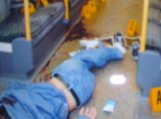
Menezes lying in the carriage after his murder

THE police officers who shot dead innocent suicide bomb suspect Jean Charles de Menezes at a Tube station last year will not face charges, according to a tabloid newspaper.

There is insufficient evidence of criminal offences in the shooting of the 27-year-old Brazilian at Stockwell Station, in south London, on July 22, according to a lawyer reviewing the case for the Crown Prosecution Service.

Mr De Menezes was shot in the head seven times by officers who mistook him for a suicide bomber in the wake of last July’s London bombings.

The lawyer quoted in The Sun said: “Mistakes were made but they do not amount to criminal misconduct.

“The firearms officers were acting under orders. Those in charge of surveillance believed he was a suspect.

“There is no realistic prospect that they will be prosecuted.”

In other news, it seems that Brian Paddick a Scotland Yard deputy assistant commissioner is being kicked off the force, for the crime of testifying against Ian Blair, the Metropolitan Police commissioner:

Friends of Paddick said he had been offered the option of going on “gardening leave” for the next six months. This would last until November, when he has the option of retiring with a full police pension after 30 years’ service.

If agreed, the deal would mean Paddick spending half a year being paid £52,000 — half his estimated £104,000 annual salary — for doing nothing.

The Met has offered Paddick the alternative of taking a posting involving a “less visible position” that would mean him rarely visiting Scotland Yard. Colleagues say Paddick, who was on holiday last week, is now considering his options.

[…]

Earlier this year Paddick gave investigators from the Independent Police Complaints Commission a signed statement that appeared to contradict Blair’s account of the aftermath of the shooting.

Paddick testified that Moir Stewart, a key member of Blair’s private office, had been told just six hours after the shooting that police might have killed an innocent man.

Blair has maintained that the first he and his advisers knew of the error was 24 hours after the shooting.

It seems the coverup is in full effect. And it seems nobody is paying attention anymore, as I haven’t seen either story mention on the usual blogs. Will the Metropolitan Police really get away with another murder?